
Meta weighing 10,000+ layoffs to fund GPUs. The US quietly pulling back a sweeping AI chip export rule. A $20B autonomy contract from the Army. A China foundation model startup jumping to an $18B valuation in three months. And a CEO using an LLM as his first engineer on a personal medical tool.
The throughline: AI is no longer a “growth bet” sitting on top of existing structures. It is the structure. Headcount, export policy, defense doctrine, and founder behavior are all being rewritten around model, data, and compute leverage.
Capital is now treating AI capability like energy or oil, a national asset with its own geopolitics and procurement logic. At the same time, inside companies, the real constraint is shifting from access to models and infra to whether your leaders and ICs are willing to change how they work and what “craft” means.
If your 2026 plan assumes you can “layer AI in” without re-architecting budgets, org charts, and decision rights, you’re running a legacy playbook in a new regime.
BLUF
At Neue Alchemy, we support leaders navigating inflection points, when tech, capital, and policy converge. If your roadmap is already in motion and you're pressure-testing execution, we're open to conversations.
We also reserve capacity for education, SMBs, and mid-market leaders, those starting, mid-flight, or seeking outside perspective before systems harden.
CAPITAL FLOWS / LABS
China’s Moonshot and Western mega-rounds: AI is now priced as national infrastructure
Moonshot AI raised new capital at a roughly $18B valuation, up from ~$3B in December, per Bloomberg. The deal reportedly includes participation from existing backers and reflects aggressive revenue and capability expectations in China’s foundation model race.
This jump, ~6x in three months, puts a two-year-old Chinese lab into the same valuation band as several Western frontier players, with state-aligned capital implicitly underwriting long-term compute and data spend.
The Bet: China is assuming that overcapitalizing a small number of national champions is the fastest path to closing any model gap with the US.
So What? AI labs are now being capitalized like sovereign infrastructure, not startups. That changes your competitive set: you’re not just competing with a company, you’re competing with a country’s balance sheet and industrial policy.
For infra, tooling, and data vendors, this means Chinese labs will have the budget to build or buy most of what they need, and to run inefficiently in the short term to gain capability. For Western operators, it means the “China is behind” narrative is a dangerous assumption to bake into your product and market timing.
The Risk: Policy risk is now as material as product risk. Export controls, data localization, and sanctions can reprice these assets overnight. If you’re entangled with both US and Chinese ecosystems, misjudging the policy window can strand your product between two incompatible regimes.
Action: • Map your exposure: list every dependency, chips, cloud regions, data vendors, that touches both US and China-facing AI stacks. • If you sell infra or tools, decide explicitly whether you are “US-first,” “China-first,” or “dual-stack” and align GTM, compliance, and roadmap accordingly. • In board materials, stop treating Chinese labs as distant competitors; model them as peers with equivalent or greater access to capital and compute over a 3–5 year horizon.
CORPORATE STRUCTURE / AI CAPEX
Meta’s layoffs: GPUs over people is now an explicit trade
Meta is planning sweeping layoffs that could affect 20% or more of the company, potentially 15,000–16,000 roles, amid mounting AI infrastructure costs, per Reuters. A separate report suggested leadership is weighing major cuts as it pours billions into AI, per Business Insider.
This isn’t a one-off restructuring. It’s a clear signal: at hyperscaler scale, AI infra is now a line item large enough to force double-digit percentage headcount decisions.
The Bet: The market will reward trading legacy org layers for model and infra leverage, even if it means near-term cultural and execution risk.
So What? Your 2026 budget is no longer “add AI on top.” It’s a zero-sum reallocation. If a company with ~79,000 employees is willing to cut 20% to fund GPUs and model work, every public operator now has cover, and pressure, to do the same.
This changes internal politics. AI is not a side project; it’s the reason some teams will shrink or disappear. If you don’t make that trade explicit, you’ll get shadow resistance from orgs that sense the threat but aren’t given a path to participate.
The Risk: Cutting too deep in non-ML functions, product, ops, compliance, frontline CX, can leave you with powerful models and no organizational muscle to deploy them safely or profitably. There’s also a morale risk: if AI is framed as the thing that cost people their jobs, adoption will stall inside the org.
Action: • This week, draft a simple “AI P&L” view: what you’re spending on models/infra vs. what you’re willing to sunset in legacy systems and headcount over 12–24 months. • Identify two to three org layers or functions where AI leverage is highest and make them explicit beneficiaries, not victims, of reallocation. Fund them with savings from low-leverage work. • Start communicating internally that AI investment is a trade, not a free lunch. Clarity now beats quiet, slow-rolling cuts later.
SOVEREIGNTY / EXPORT CONTROLS
US export rule pulled back: a brief window for global AI chip flows
A US government website shows the Commerce Department withdrew a planned rule that would have tightened AI chip exports globally, requiring export permits to almost all countries, after circulating a draft for interagency feedback in February, per Reuters.
The withdrawal doesn’t mean controls are off the table. It means the specific mechanism, broad permit requirements, is being reworked.
The Bet: The US is trying to slow adversary access to advanced AI hardware without crippling allied supply chains and commercial players.
So What? You have a temporary reprieve on global AI chip flows. But the direction of travel is still toward tighter, more targeted controls over the next 6–18 months.
If your AI infra strategy assumes frictionless access to top-tier accelerators in any region, you’re exposed. The real structural shift is that compute geography is now a policy variable, not just a cost and latency decision.
The Risk: Waiting for “final rules” is the risk. By the time a new draft lands, capacity in permissive regions will be spoken for, and you’ll be competing with hyperscalers and national programs for the same racks and megawatts.
Action: • Map your current and planned GPU deployments by jurisdiction, down to data center and cloud region, and flag any that rely on export-sensitive SKUs. • Start diversifying: secure capacity in at least one jurisdiction with lower policy volatility for your critical workloads. • If you’re a vendor, build a clear story for customers on how your architecture handles future export tightening, including fallbacks to different SKUs or regions.
DEFENSE / DUAL-USE
Anduril’s $20B ceiling: autonomy as an operating system, not a gadget
The US Army awarded Anduril a 10-year contract worth up to $20B for software, hardware, and services, including a 5-year optional ordering period, per Bloomberg. The deal covers a broad autonomy and defense stack, not a single product.
This is one of the largest validations to date that software-first autonomy, with integrated hardware and services, is a core military capability, not an experiment.
The Bet: Defense is standardizing on full-stack autonomy platforms that can be extended over a decade, rather than buying point solutions.
So What? For dual-use builders, the ceiling on software + hardware + services bundles just moved up an order of magnitude. The Pentagon is willing to treat a commercial-origin stack as an operating system for parts of the battlespace.
This changes how you should think about product scope. Narrow tools that don’t plug into a broader autonomy or C2 fabric will struggle to clear procurement friction. Platforms that can own the orchestration layer, with pluggable sensors and effectors, now have a reference contract to point to.
The Risk: Over-rotating into defense without understanding procurement cycles, security requirements, and political risk can strand your roadmap. A 10-year IDIQ headline doesn’t equal immediate revenue; drawdowns depend on performance, budgets, and shifting priorities.
Action: • If you’re building dual-use, decide whether you’re aiming to be a platform or a module. Your architecture, pricing, and BD strategy should reflect that choice. • Start mapping your product to existing programs of record and autonomy initiatives; don’t pitch “AI for defense” in the abstract. • Tighten your compliance posture, export controls, security clearances, data handling, so you’re not disqualified before you reach technical evaluation.
ORG DESIGN / ADOPTION
Bret Taylor’s struggle: the real AI blocker is identity, not capability
OpenAI Chairman Bret Taylor described it as “hard, emotionally” to let AI write his code, saying he has “a hard time not caring” and still hand-codes despite knowing tools can help, per Business Insider.
This is a senior technical leader, at the center of the AI ecosystem, articulating the same resistance your staff engineers feel, using AI looks like giving up part of their craft.
The Bet: Cultural change will lag technical capability; leaders will keep coding “by hand” longer than is economically rational because their identity is tied to it.
So What? Your AI adoption problem is not “the models aren’t good enough.” It’s that your highest-status ICs and leaders define their value by doing the work themselves.
If you ignore this, you’ll see quiet non-use of tools, shadow processes, and a widening gap between what your strategy deck says and what actually happens in the repo or the CRM. AI won’t fail because it’s weak; it will fail because your best people feel threatened by it.
The Risk: If you push AI as pure efficiency, “do more with less”, without redefining what “craft” means, you risk losing or demotivating your top talent. They’ll either resist adoption or leave for environments where their identity as builders is respected in a new way.
Action: • This week, talk directly with 3–5 senior ICs about how they feel using AI tools, not whether they “like” them, but what it does to their sense of mastery. Listen. • Redefine craft in your org narratives: celebrate people who design systems, review AI output, and orchestrate workflows, not just those who type every line. • Make AI usage visible and high-status: include “AI leverage” in performance conversations and promotion criteria for technical and non-technical roles.
FOUNDER BEHAVIOR / PRODUCT SURFACE
Tobi Lütke’s MRI viewer: CEO as PM, AI as first engineer
Shopify CEO Tobi Lütke used Claude to read his MRI report, then had it help spec and build a web-based MRI viewer, per Business Insider. He acted as domain expert and product manager, with the model effectively serving as his initial engineering resource.
This is not a side project story. It’s a pattern: senior leaders using models directly to prototype tools around their own workflows and curiosities.
The Bet: The fastest path from idea to product is now “executive with a model,” not “executive → product → eng → backlog.”
So What? If your leadership still thinks in “submit a ticket to IT” terms, you’re behind. The new competitive behavior is executives personally prototyping with models on nights and weekends, then handing working artifacts to teams to harden and scale.
This compresses product cycles and changes who has permission to build. It also means your shadow IT risk is going to explode if you don’t give leaders safe, governed environments to experiment.
The Risk: Unstructured executive tinkering can create security, compliance, and architectural debt if prototypes leak sensitive data or become production-critical without proper review. There’s also a prioritization risk: charismatic leaders’ pet projects can crowd out more important, less flashy work.
Action: • Stand up a “sandbox” environment for leaders to build with models, with guardrails on data access, logging, and export. Make it the default place for this behavior. • Pair one strong staff engineer or architect with your most experimental executives as a “model sherpa” to turn promising prototypes into real roadmaps. • Update your product intake process to accept AI-built prototypes as inputs, with a clear review gate, instead of forcing everything through a blank-spec backlog.
INFRA / DATA & ML PLATFORM
Databricks serverless workspaces: infra excuses just expired
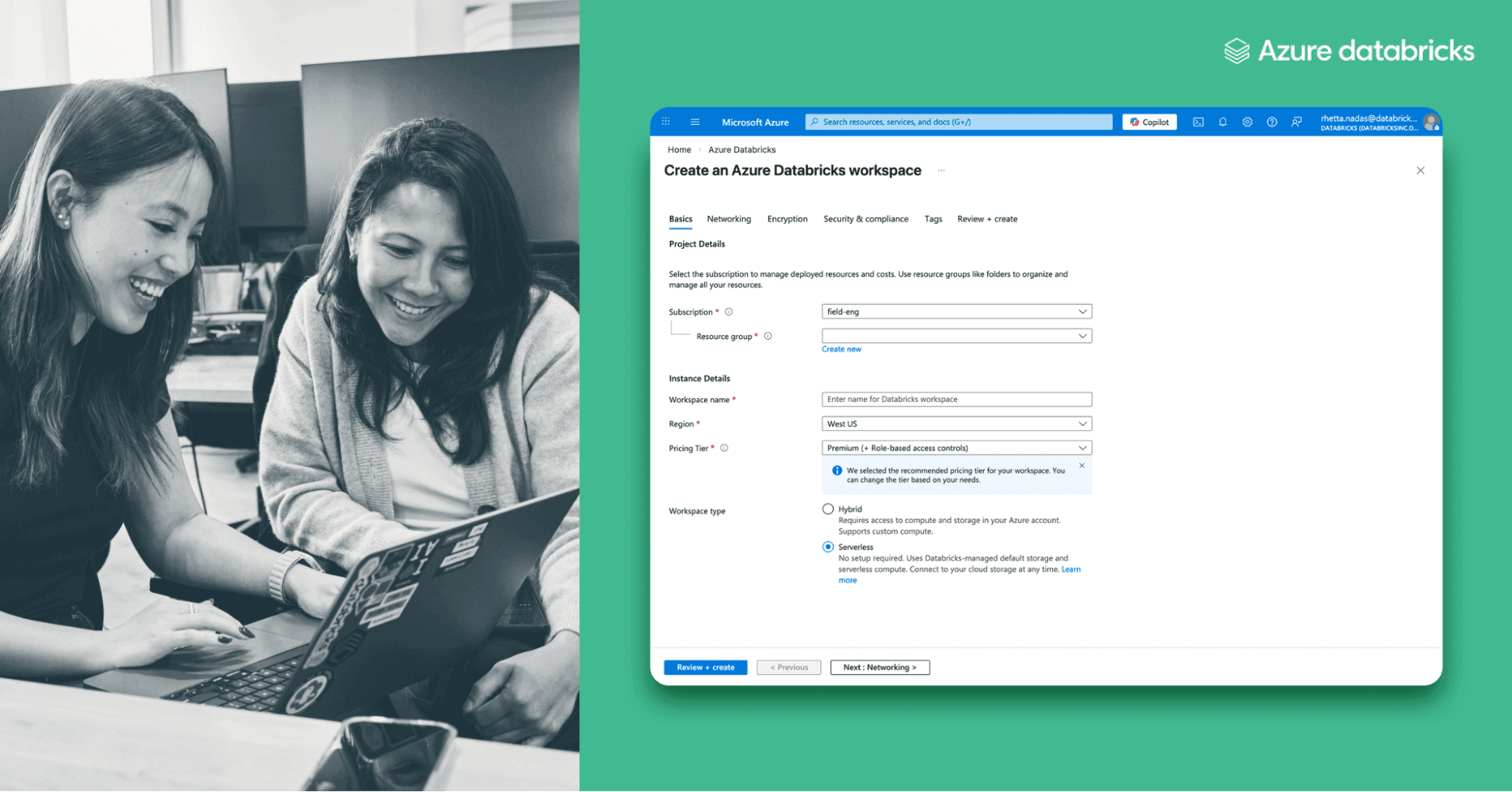
Databricks announced that Serverless Workspaces in Azure Databricks are now generally available, per the Databricks Blog. Teams can spin up data and ML environments without managing clusters, with compute billed purely on consumption.
This turns a big chunk of data and ML infra from capacity planning and cluster wrangling into an on-demand service.
The Bet: The bottleneck in data and ML velocity is organizational, permissions, governance, and skills, not hardware.
So What? If your data science and ML teams are still “waiting on clusters,” that’s now an org design failure, not an infra constraint. Serverless workspaces remove a traditional excuse for slow experimentation and long lead times.
This also changes your cost profile. You’re trading fixed capacity for variable spend. Without governance and cost visibility, you’ll either overspend or clamp down so hard you recreate the old bottlenecks.
The Risk: Unmetered experimentation can blow up your cloud bill. Conversely, overreacting with heavy-handed approvals can kill the very agility serverless is supposed to unlock.
Action: • Enable serverless for a defined set of teams and projects this week, don’t boil the ocean. • Put simple, visible cost dashboards in front of those teams and give them budgets they own. Treat them as adults, not children. • Rewrite your internal “how to get infra” process to assume serverless as the default path, with cluster-based exceptions for only the heaviest, most predictable workloads.
IN PRACTICE
We’re seeing the same pattern across clients: the tech is ready, the capital is flowing, but the org is stuck in 2018.
One manufacturing client spent months debating GPU SKUs while their data team still filed tickets for cluster access. The unlock wasn’t a better hardware choice, it was moving to a serverless model and rewriting who could provision environments.
Another client in financial services had a CEO privately prototyping AI tools for their own workflow while the official AI program was still in “use case inventory” mode. The real work was building a bridge between those executive prototypes and the formal roadmap, without letting pet projects hijack the portfolio.
The consistent lesson: the constraint is not access to models or chips. It’s decision rights, identity, and budget structure.
For the full breakdown, reach out for a Field Report.
CONTRARIAN SIGNAL
AI “job loss” is the wrong frame, it’s a bargaining power reset
The dominant narrative is still about AI “taking jobs,” especially for white-collar, humanities-trained workers, as Alex Karp framed it in recent comments about displacement risk for “humanities-trained, largely Democratic voters,” per Business Insider.
That framing misses the structural shift. The real story is not headcount loss; it’s a re-pricing of bargaining power between credential-heavy, task-repetitive roles and operators who control data, models, and infra.
When Meta trades thousands of knowledge workers for GPUs, and defense spends $20B on autonomy platforms, the message is clear: the locus of leverage is moving from “I know how to do this task” to “I own the system that does these tasks.”
If your workforce strategy is focused on “reskilling” without changing who owns the systems, you’re training people for jobs whose bargaining power is already eroding.
The Takeaway: Staff for system ownership and orchestration, not just task execution. The winners in this cycle will be the people, and organizations, that control the levers, not the ones who are best at pulling them by hand.
THE QUESTION FOR TODAY
Meta is preparing to trade tens of thousands of roles for GPUs. China is capitalizing AI labs like national infrastructure. The US is rewriting export rules in real time. Your executives are starting to prototype with models on their own. Your senior ICs are emotionally attached to doing the work by hand.
Are you explicitly redesigning your org, budgets, and decision rights around AI leverage, or are you hoping you can bolt it onto a structure that was optimized for a different era?
See exactly how this impacts your specific industry and function. Upgrade to PRO to get bespoke tactical breakdowns generated instantly for your operating model.
Go deeper with the Weekly Signal
This is the daily take. The Weekly goes further — full strategic analysis across 8–10 sections, each with a signal read and operator action items. Source panel included.
Sign up free → then upgrade