
Amazon quietly added 29 more satellites to its LEO constellation. Apple rewired how subscription economics work for everyone outside the US. Xiaomi dropped open-source manipulation agents. And jury selection began for a court case that will drag AI governance into discovery.
On the surface, these are unrelated: rockets, app store billing, robot claws, and a lawsuit.
Underneath, they’re the same story: control of the stack.
Clouds are becoming network operators. Platforms are becoming quasi-SaaS vendors. Robotics is turning core capabilities into open commodities. And AI governance is moving from “trust us” to “show us the documents.”
If your 2026 plan assumes you can sit comfortably in the middle, renting infra from one giant, distribution from another, and models from a third, yesterday was a reminder: the middle is exactly where the squeeze is coming.
INFRASTRUCTURE / ORBITAL BACKBONE
Amazon turns LEO into AWS’s private lane
Amazon / ULA launched 29 Project Kuiper LEO satellites on an Atlas V from Cape Canaveral, continuing buildout of Amazon’s broadband constellation, per Spaceflight Now.
This is part of Amazon’s plan to field thousands of satellites to support global connectivity and integrate with AWS and its retail/logistics footprint.
The Bet: Cloud, retail, and AI workloads will increasingly ride on vertically controlled space infrastructure rather than third-party networks.
So What? Amazon isn’t just a tenant on telecom backbones anymore, it’s building its own. That changes the economics and routing of latency-sensitive workloads, especially for edge AI, logistics, and high-value enterprise traffic. If AWS can steer premium customers onto Kuiper-backed paths, “multi-cloud” that ignores network control is a half-model.
The Risk: Regulators and rivals will scrutinize any preferential treatment of Kuiper for AWS traffic as a competition and neutrality issue. Technical integration risk is non-trivial, if Kuiper underperforms on latency, reliability, or cost, the vertical story weakens and customers won’t follow.
Action: • Map your most latency- and bandwidth-sensitive workloads to their network dependencies, know where you’re exposed to someone else’s pipes. • If you’re deep on AWS, ask your account team this week how Kuiper will show up in your architecture and pricing over the next 12–24 months. • If you’re building networked products (IoT, robotics, remote ops), design for a world where your hyperscaler is also your network operator, or explicitly hedge with alternative connectivity.
PLATFORMS / MONETIZATION
Apple quietly turns apps into contract SaaS
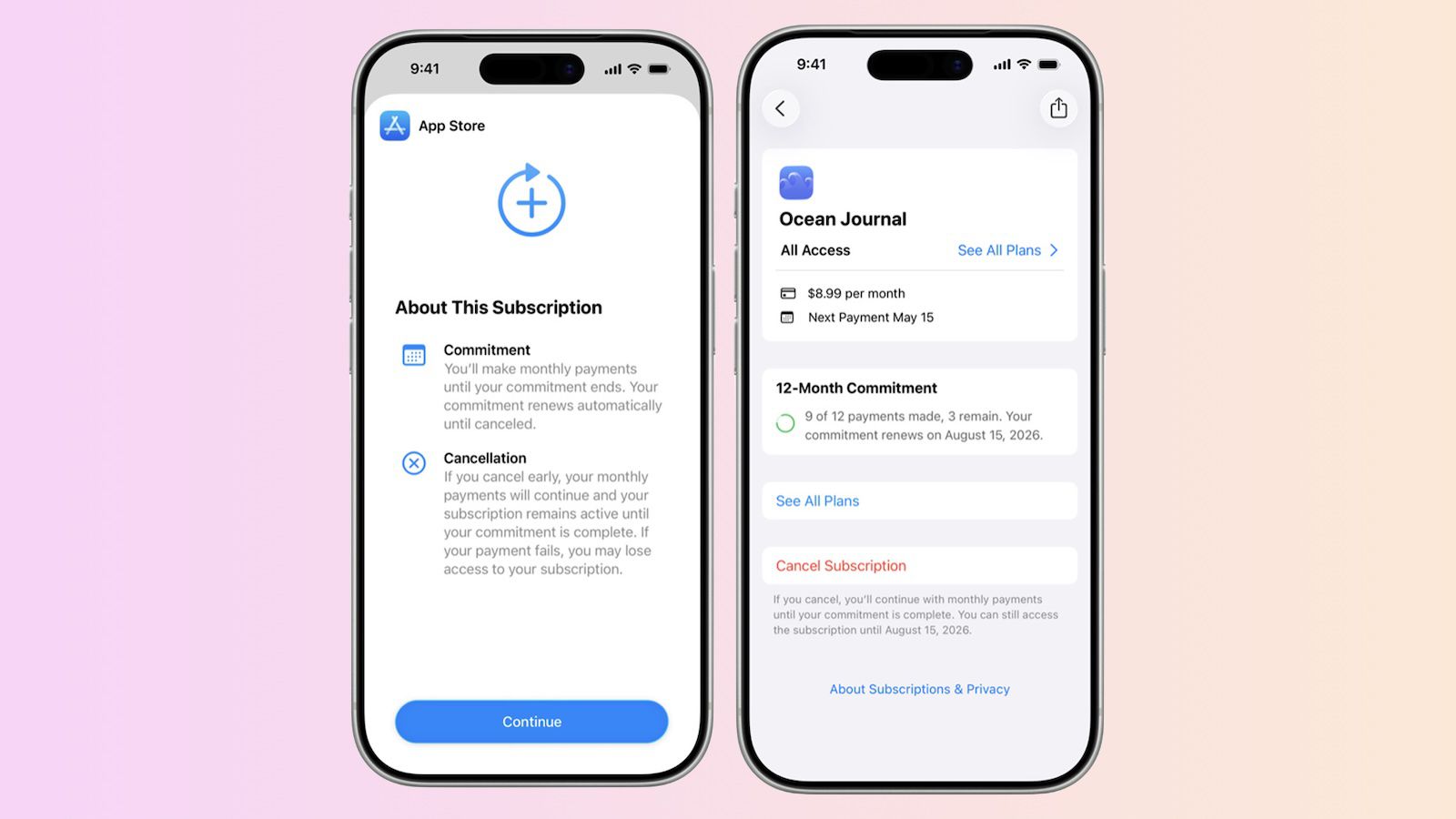
Apple will allow developers outside the US and Singapore to offer 12‑month commitment monthly subscriptions on the App Store starting in May, per MacRumors.
Users commit for a year of monthly payments, effectively annual contracts with App Store billing and Apple’s existing rev share and refund rules.
The Bet: Apple wants to capture more SaaS-like LTV and lock-in on-platform, while giving developers a retention lever that keeps them from churning to web or alternative billing.
So What? This is a structural change in consumer and prosumer software economics. You can now run a contract-like model, predictable revenue, lower churn, without standing up your own billing stack, but Apple sits in the middle of the relationship. For operators, that’s a trade: higher LTV and simpler ops in exchange for platform dependency and less pricing agility.
The Risk: Regulatory pressure on App Store terms is not going away. If authorities decide 12‑month commitments are anti-consumer or lock-in, this window can narrow fast. And if you lean too hard into annual commitments without matching product value, you’ll spike refunds, chargebacks, and reputational drag.
Action: • If you monetize outside the US/Singapore, run the numbers this week on 12‑month commitments vs current monthly/annual mix, model churn, LTV, and Apple’s cut explicitly. • Design at least one pricing experiment, e.g., commitment-only for high-intent cohorts, and get it queued for launch in May, not “sometime this year.” • Update your retention and roadmap planning to match the commitment, if you’re taking a year of payments, your feature and support cadence needs to justify a year of trust.
PARTNERSHIPS / MODEL DISTRIBUTION
OpenAI and Microsoft loosen the model–cloud bond
OpenAI and Microsoft amended their partnership so OpenAI can serve customers across multiple cloud providers, while Microsoft keeps access to OpenAI technology through 2032 but no longer on an exclusive basis, per OpenAI and CNBC.
OpenAI's announcement framed the change as a simplification of the relationship with more long-term clarity and broader delivery of AI benefits.
The Bet: The model layer is getting more portable even if the infrastructure layer stays concentrated. OpenAI is betting distribution flexibility matters more than exclusive hyperscaler alignment, while Microsoft is betting durable access matters more than exclusivity itself.
So What? This is a structural change in frontier AI go-to-market, per NYT. If you assumed leading model access would remain tightly fused to one cloud, that assumption just weakened. Builders now need to separate model concentration risk from cloud concentration risk instead of treating them as the same thing.
The Risk: The revised terms create more room for strategic drift between platform, provider, and model lab, per The Register. If your architecture, procurement posture, or enterprise pricing assumed Microsoft's exclusive position would hold, your negotiating leverage may now look different.
Action: • Recheck any roadmap assumptions that tie OpenAI access to Azure by default. • Treat model portability and cloud portability as separate design questions. • Expect enterprise buyers to push harder on neutrality, redundancy, and rights to move workloads across providers.
ROBOTICS / EMBODIED AI
Xiaomi makes manipulation agents a commodity
Xiaomi open-sourced its MiMo‑V2.5 and MiMo‑V2.5‑Pro models for agentic “claw” tasks under the MIT License, claiming they are among the most efficient available for manipulation, per VentureBeat.
These models target robotic manipulation and pick-and-place style tasks, optimized for efficiency and deployability on constrained hardware.
The Bet: Core manipulation intelligence is no longer proprietary edge, Xiaomi is betting the real moat is hardware, data, and integrated systems, not the model weights themselves.
So What? If you’re building robots, automated warehouses, or pick systems, your baseline just changed. A “good enough” open, MIT-licensed manipulation brain is now on the shelf for everyone, including your competitors and customers. The defensible layer shifts to fleet operations, uptime, integration with WMS/ERP, and domain-specific data loops.
The Risk: Commoditizing core models can compress margins for vendors who haven’t built operational or data moats yet. And if everyone standardizes on a few open models without rigorous safety and validation, you inherit correlated failure modes across fleets.
Action: • Audit your robotics stack this week: what’s truly proprietary, data, control, tooling, versus what could be swapped for MiMo-class open models. • If you’re early-stage, stop pitching “our manipulation model” as the moat; start building and measuring fleet-level KPIs, MTBF, task success rates, recovery workflows. • If you’re a warehouse or manufacturing operator, task your team to prototype an open-model-based cell, not to ship, but to understand how fast you could switch vendors if needed.
GEOPOLITICS / AI OWNERSHIP
China makes AI ownership a contested layer of the stack
China blocked Meta's $2 billion acquisition of Manus and ordered the parties to unwind the transaction, citing existing laws and regulations and concerns around foreign control of a Chinese-founded AI asset, per CNN and CNBC.
The Bet: Beijing is signaling that certain AI capabilities are strategic assets, even when the company has international structure, foreign investors, or offshore packaging.
So What? AI M&A is no longer just about product, talent, or speed, per Fortune. Ownership itself is now a contested layer of the stack. If your growth strategy assumes you can buy critical AI capability across borders, sovereign review is becoming part of the product roadmap.
The Risk: More deals will carry reversal risk long after commercial terms are signed, per BBC. Founders, acquirers, and investors now have to price in the possibility that a regulator can redefine what counts as a permissible transfer of AI capability.
Action: • Build export-control, foreign-ownership, and technology-sovereignty analysis into diligence up front. • Treat jurisdictional exposure as a strategic variable, not just a legal footnote. • If you depend on overseas labs or acquisitions for capability jumps, map which assets a state could plausibly classify as sensitive.
GOVERNANCE / LEGAL
OpenAI vs Musk turns AI governance into case law
Jury selection began in the lawsuit between Elon Musk and OpenAI, kicking off a trial that will probe alleged mission drift, commercialization choices, and governance at the lab, per Gizmodo.
At the same time, Musk amplified a New Yorker article alleging deceptions around OpenAI’s evolution, as his separate lawsuit heads to trial, per Wired.
The Bet: Governance, fiduciary duty, and “for-benefit” AI missions can be contested, and potentially constrained, in court, not just in boardrooms.
So What? This is the first major test of whether AI lab charters, safety promises, and nonprofit/for-profit hybrids are legally binding or just branding. Discovery will drag internal emails, board minutes, and partner contracts into the open. If you’re building on third-party models, your vendor’s governance story is now a legal risk factor, not just a PR narrative.
The Risk: A messy, high-profile trial can harden public and regulatory skepticism, leading to blunt rules that don’t distinguish between responsible and reckless actors. And if courts set narrow interpretations of “mission” or fiduciary duty, hybrid structures and flexible governance could become harder to maintain.
Action: • Pull your own charter, mission statements, and safety claims this week, make sure they align with actual practice and board oversight, not aspirational copy. • If you depend on a single model vendor, review your contracts for change-of-control, mission change, and audit/assurance rights, and start a diversification plan if you have none. • Brief your legal and comms teams together: assume your AI roadmap and governance could be read aloud in court; adjust how you document decisions accordingly.
DEFENSE / CONTRACTUAL BOUNDARIES
Google shows where the defense-AI line is moving
Google reportedly signed a classified agreement allowing the Pentagon to use its AI models for "any lawful government purpose," including classified work, with reported safeguards that may not give Google veto authority over operational decisions, per 9to5Google and The Verge.
Hundreds of Google employees, more than 600 signatories, then asked leadership to block classified AI work with the Pentagon, explicitly opposing Google filling the gap left by Anthropic's withdrawal from a defense contract, per Gizmodo.
The Bet: The real defense-AI line is no longer whether labs work with governments. It is what contractual language permits after access is granted, and whether the organization has the internal legitimacy to support it.
So What? This makes defense AI concrete. "Lawful use" is not the same as meaningful operational constraint. Once a model vendor signs away downstream control, the debate shifts from principles to enforcement: who decides permissible use, who audits it, and whether employees believe the governance is real.
For operators, this is the new sensitive-sector playbook: contract language, technical controls, employee trust, and public legitimacy all have to move together. Model performance alone is not enough.
The Risk: If access expands faster than governance, companies invite employee backlash, leaks, reputational damage, and internal fracture. But if major labs self-limit without a clear alternative, defense work may shift to smaller, less scrutinized vendors with weaker safety practices.
Action: • Review sensitive-sector agreements for downstream use, oversight, veto rights, and enforcement. • Do not treat "lawful use" language as equivalent to meaningful operational constraint. • Align legal, policy, technical controls, and internal comms before pursuing defense or intelligence workloads. • If you are a defense buyer, evaluate vendors on governance maturity and internal legitimacy, not just benchmarks and price.
SECURITY / CONNECTED DEVICES
Phishing now equals physical risk
Hackers obtained data on approximately 5.5 million ADT home security customers via a phishing attack on an ADT employee, exposing names, addresses, and system details, per Mashable.
The attackers reportedly gained access to internal tools and sensitive customer information, raising concerns about both privacy and physical security.
The Bet: Attackers understand that compromising a single human in the loop of a connected-device provider yields leverage over both data and physical environments.
So What? This is not just another SaaS breach. When your product controls doors, cameras, or alarms, a compromised CRM or support console becomes a physical threat vector. Regulators and insurers will increasingly treat connected-device operators as critical infrastructure, with expectations for phishing defense, access control, and incident response to match.
The Risk: If you underinvest in human-centric security, training, phishing-resistant auth, least-privilege access, you’re effectively underwriting both cyber and physical incidents. And once customers connect “your breach” with “my family’s safety,” brand recovery is slow and expensive.
Action: • Identify every internal tool that can view or control customer physical environments, lock down access, logging, and MFA this week. • Run an immediate phishing simulation and training refresh for any staff with access to those tools; treat failure rates as a board-level metric. • Update your incident response playbook to explicitly cover physical-risk scenarios, law enforcement coordination, customer notification, and rapid control revocation.
IN PRACTICE
Designing for a world where infra, platform, and model are all moving targets
The throughline across Kuiper, Apple’s commitments, Xiaomi’s open models, the OpenAI–Microsoft reset, China’s Manus veto, and Google’s Pentagon agreement is simple: the layers you used to treat as stable are now strategic variables.
Most operators still plan as if: • Network is a commodity you rent. • App store rules are annoying but static. • Core AI capabilities are proprietary and scarce. • Governance is an internal matter.
None of those are safe assumptions.
Neither is the assumption that model distribution rights, cross-border AI ownership, or downstream use controls will stay fixed once a deal is signed.
The practical move is to build “optionality by design” into your stack: network abstraction that can route around a hyperscaler’s private lane; pricing and packaging that can shift if Apple tightens or loosens control; AI systems that can swap between open and closed models; governance that can withstand both employee scrutiny and legal discovery.
For the full breakdown, reach out for a Field Report.
CONTRARIAN SIGNAL
The real AI moat isn’t your model, it’s your constraints
The consensus story is still about capability: faster models, better manipulation, more satellites, more compute.
The structural story is about constraints.
Xiaomi is giving away manipulation brains. Google’s employees are constraining which contracts leadership can sign. Courts are about to constrain how AI labs can evolve their missions. Apple is constraining, and monetizing, how you structure your customer relationships. Amazon is removing one constraint, third-party networks, by owning the orbital layer.
The organizations that win in this environment won’t be the ones with the “best” models or the most satellites. They’ll be the ones that treat constraints as design inputs, legal, ethical, distribution, and infra, and build systems that stay viable as those constraints tighten and shift.
The Takeaway: Stop asking “what can we build with this model or this infra” and start asking “what stays resilient as governance, labor, and platform rules move under our feet.”
THE QUESTION FOR TODAY
Your cloud provider is becoming your network operator. Your app platform is becoming your contract counterparty. Your model vendor is becoming a legal and reputational risk surface. Your own employees are becoming a gating function on which customers you can serve.
Does your current architecture, technical, commercial, and organizational, still work if every layer above and below you starts acting in its own strategic interest?
⸻
See exactly how this impacts your specific industry and function. Upgrade to PRO to get bespoke tactical breakdowns generated instantly for your operating model.
Go deeper with the Weekly Signal
This is the daily take. The Weekly goes further — full strategic analysis across 8–10 sections, each with a signal read and operator action items. Source panel included.
Sign up free → then upgrade