
Yesterday's signals, distilled, A look back at July 8, 2026.
Voice went from feature to surface.
OpenAI didn’t just ship a nicer “talk to ChatGPT” mode. Full‑duplex changes the interaction contract, interruptions, overlap, pacing, and silence become product primitives. That pulls voice out of the “accessibility” bucket and into the core workflow stack: support, field service, sales, clinical intake, dispatch.
At the same time, regulators tightened the definition of “edge case” for autonomy. NHTSA’s first‑responder directive is a forcing function, scenario coverage, OTA update discipline, and incident reporting become operating costs, not R&D hygiene.
Underneath both: the market is converging on real‑time systems that must behave correctly in public. Not just “answer correctly,” but “interact correctly”, with humans, with institutions, with emergency services, with platforms that arbitrate truth.
The strategic question operators should sit with this week: where are you still treating real‑time interaction as UX polish, when it’s becoming compliance, brand risk, and distribution?
CAPABILITY / VOICE INTERFACES
Full‑duplex voice becomes a default interaction layer
OpenAI introduces GPT‑Live in ChatGPT OpenAI launched GPT‑Live, full‑duplex voice that can listen and speak at the same time, enabling interruption (“barge‑in”) and more natural pacing, per OpenAI. The release frames voice as a first‑class interface, not a wrapper around text chat.
The practical shift is not “better speech.” It’s conversational control: turn‑taking, latency tolerance, and when the system should stop talking.
So What? If you run customer support, inside sales, or field operations, voice is now a competitive surface where users will compare you to the best consumer assistant they already use. The bar is moving from “can it answer” to “can it behave”, interruptions, silence, escalation, and handoff are now part of perceived competence.
This also changes build-vs-buy math. A “good enough” voice layer is harder to fake, because the failure modes are social, not just factual.
The Risk: Full‑duplex increases safety and brand exposure: accidental interruptions, talking over distressed users, or mis-timed confirmations can create real harm in regulated contexts. It also increases the chance that sensitive data is spoken aloud in the wrong environment, voice is a leakage vector.
Action:
- Audit your highest-volume call flows and identify where interruption and silence are mission-critical (payments, cancellations, medical, safety, dispatch).
- Add a “conversational QA” checklist to acceptance testing, barge‑in, latency, recovery after misunderstanding, and escalation timing.
- Decide where you will not use voice yet, document the red zones (HIPAA-like contexts, minors, high-stakes financial actions) and enforce them in product.
ROBOTICS / AUTONOMY POLICY
“Edge cases” get deadlines
NHTSA orders AV developers to address first‑responder interference NHTSA issued a directive to automated vehicle developers to stop driverless vehicles from obstructing or interfering with first responders, per NHTSA. The agency’s posture is explicit: emergency-scene interaction is a baseline safety requirement, not an acceptable long-tail failure.
This lands as a compliance clock for any operator running AVs in mixed public environments.
So What? Autonomy is entering a phase where regulators will specify scenarios, not principles. That pushes teams toward “operational safety engineering” over “model improvement”, runbooks, OTA update cadence, incident telemetry, and proof artifacts become as important as perception and planning.
For adjacent robotics (delivery bots, warehouse-to-curb systems, drones near public infrastructure), expect the same pattern: scenario-based requirements tied to public safety stakeholders.
The Risk: Scenario compliance can become brittle, teams optimize for the test, not the street. And if requirements vary by jurisdiction, fleets fragment into policy-driven configurations that are expensive to maintain.
Action:
- Map every deployment geography to first‑responder protocols, who has authority on-scene, what signals are used, what “safe stop” means locally.
- Build an OTA “hotfix lane” with audit trails, assume you will need rapid updates tied to regulator-visible incidents.
- Instrument and retain emergency-scene telemetry now, if you can’t reconstruct behavior, you can’t defend it or fix it.
TRUST / CONTENT PROVENANCE
Watermarks move from theory to incident response
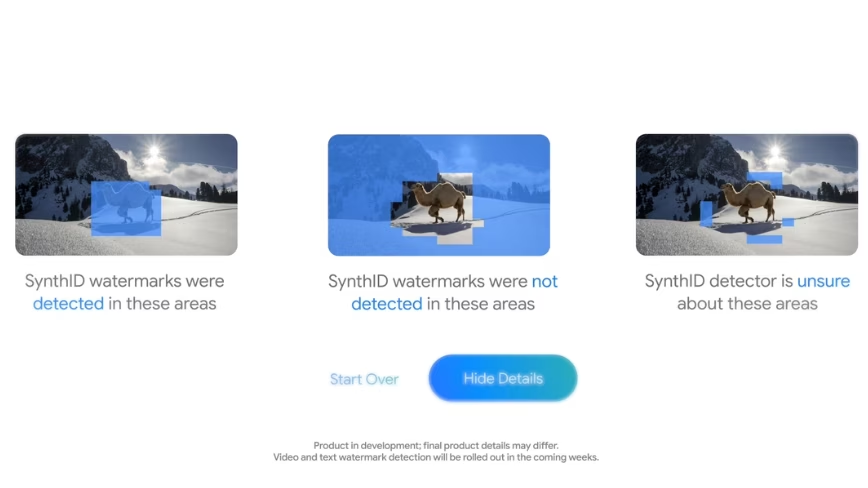
Google’s SynthID watermark helps debunk a viral political deepfake Google’s SynthID watermark reportedly helped identify a hoax image of Mitch McConnell, one of the first high-profile cases where a watermark was used to resolve a viral claim in the wild, per The Next Web.
The key detail is operational: provenance only matters when detection is wired into distribution and moderation workflows.
So What? Provenance is becoming an incident-response input, not a research debate. If you’re a brand, a marketplace, or a platform-adjacent enterprise, the question is whether your comms and security teams can ingest provenance signals fast enough to matter, before screenshots and reposts harden the narrative.
This also pressures vendors: “we watermark” is not a feature unless it’s queryable, monitorable, and actionable across your channels.
The Risk: Watermarks won’t cover the whole threat surface, cropping, re-encoding, and non-watermarked generation remain. Over-reliance creates a false sense of safety, especially for executive impersonation and audio.
Action:
- Add provenance checks to your crisis playbook, who verifies, what tools are used, and what threshold triggers a public response.
- Ask your creative and AI vendors how watermark signals are exposed, API access, dashboards, and third-party verification support.
- Run a tabletop exercise on a synthetic media incident, measure time-to-detection and time-to-statement.
CAPITAL FLOWS / COMPUTE GEOPOLITICS
Compute becomes rationed, and the market prices around it
China reportedly plans limited access for major AI firms to Nvidia H200s China is reportedly considering allowing some major domestic AI companies to buy a small number of Nvidia H200 chips to ease a compute shortage, per The Information. The framing matters: access is selective and policy-mediated.
This is not a “supply chain update.” It’s compute allocation as industrial policy.
So What? If you sell into China, partner with China-based firms, or rely on China-hosted AI capacity, assume uneven capability across counterparties, some will have frontier-ish compute, others won’t, and the difference will be political, not technical. That changes deal diligence: “what models can you run” becomes “what hardware access do you have, and how stable is it.”
It also increases the value of portability, workloads that can shift across accelerators, clouds, and regions become more resilient to policy shocks.
The Risk: Selective access can create sudden competitive discontinuities inside a market, partners you bet on may lose capability overnight, or gain it and change bargaining power. It also increases compliance complexity for multinationals.
Action:
- Inventory which products and internal workflows depend on China-based AI execution, document fallbacks and minimum viable performance.
- Add “compute provenance” to partner diligence, hardware class, hosting region, and expected continuity over 6–12 months.
- Prioritize portability work where it’s cheapest, containerization, model abstraction layers, and multi-provider routing for non-sensitive workloads.
CONTRARIAN SIGNAL
Voice isn’t a UI upgrade. It’s a governance upgrade.
Most teams will treat full‑duplex voice as a new channel, another interface to bolt onto the same agent stack.
The more structural read: voice forces governance into the interaction loop. When the system can interrupt and be interrupted, you need explicit policies for when it speaks, what it confirms, when it defers, and how it escalates. That’s not “prompting.” That’s product liability, brand posture, and compliance logic expressed as timing.
The organizations that win with voice won’t be the ones with the most natural prosody. They’ll be the ones that can specify and enforce conversational behavior across thousands of edge cases, then prove it.
The Takeaway: Full‑duplex voice raises the floor on interaction quality, and it raises the cost of being wrong in public.
THE QUESTION FOR TODAY
Voice is becoming the default surface for high-frequency work. Regulators are turning messy real-world scenarios into deadlines. Provenance is starting to function as an operational signal. Compute access is being allocated, not just purchased.
Where are you still relying on “best effort” behavior, when you need a spec, a test harness, and an audit trail?
Signal + Noise is strategic intelligence, not engagement-specific advice. For guidance calibrated to your org, start with Advisory.
See exactly how this impacts your specific industry and function. Upgrade to PRO to get bespoke tactical breakdowns generated instantly for your operating model.
Go deeper with the Weekly Signal
This is the daily take. The Weekly goes further — full strategic analysis across 8–10 sections, each with a signal read and operator action items. Source panel included.
Sign up free → then upgrade