
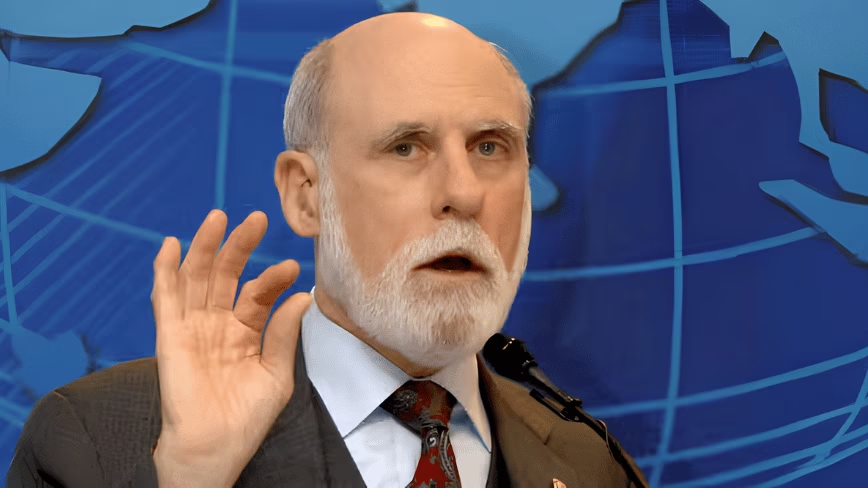
A father of the internet wants to give AI agents an identity
THE SO WHAT
Vint Cerf pushing for reliable identity for AI agents is an early move toward a trust fabric where software actors need cryptographic credentials, not just API keys. If you’re building agents, assume you’ll need to support verifiable identity and provenance—design your architectures so you can plug into emerging standards rather than retrofit later.
READ THE SOURCE
MORE FROM THE WIRE
 Applied AI
Yes, you can now order DoorDash from the command line
DoorDash exposing a CLI (dd-cli) that AI agents can use to search, cart, and order is a concrete move toward machine-to-machine commerce. If you run a consumer or local-services marketplace, you now have to decide whether to ship an agent-friendly surface or cede that layer to others.
 Applied AI
Why is OpenAI selling a ChatGPT basketball?
A branded ChatGPT basketball is less about merch and more about testing how far the assistant brand can stretch into physical culture. If you’re building on top of these ecosystems, assume the consumer-facing IP will keep expanding — your differentiation has to live in workflow and outcomes, not logo adjacency.
 Applied AI
China-Led AI Body Enlists Global South States to Rival US
A China-led World Artificial Intelligence Cooperation Organization with 29 member states — including Russia — formalizes a parallel governance and standards track for AI. Multinationals now have to plan for divergent AI rules, data flows, and preferred vendors across blocs, not a single global regime.
Applied AIHow to Train a Gen AI Kick Drum Model on Your Old Linux Desktop with 6GB VRAM
Training a kick-drum diffusion model on an old Linux box with 6GB VRAM shows how quickly generative audio is becoming a hobbyist capability. If your moat is “we can generate X media,” assume serious amateurs will soon match baseline quality on commodity hardware — your edge has to be data, taste, or distribution.