
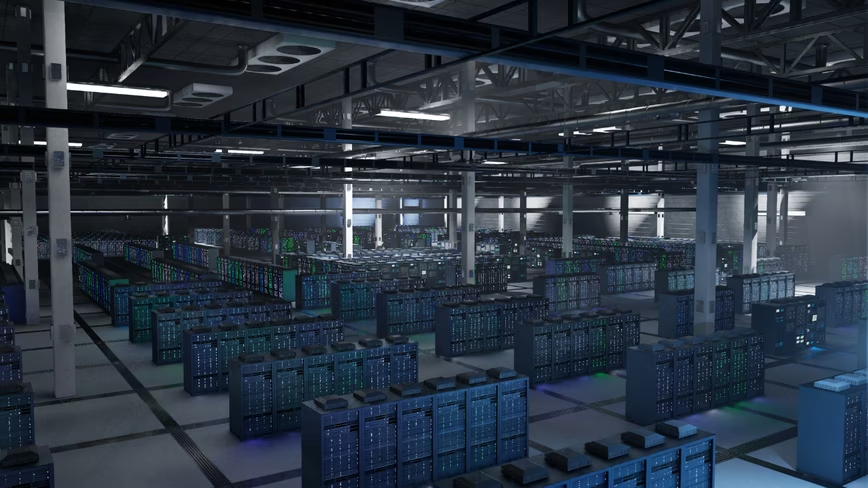
AI data centres are driving up power bills at America’s Rust Belt factories
THE SO WHAT
AI data centers are now a direct input-cost competitor to legacy manufacturing—Belden Brick’s 90% power cost jump is the new baseline risk. If you run energy-intensive operations, treat grid capacity and tariff structure as strategic variables, not utilities procurement, and explore PPAs or on-site generation before the next wave of AI buildout hits your region.
READ THE SOURCE
MORE FROM THE WIRE
 Deep & Emerging Tech
This vibrant bird’s-eye view of a chili farm in Bangladesh just won a major aerial photography award — and it was captured with a DJI Mavic 4 Pro
A major aerial photography award going to a DJI Mavic 4 Pro shot underlines how ‘pro’ visual output has fully moved into consumer drone territory. For media, mapping, and ag operators, the constraint is no longer hardware — it’s workflow, regulation, and who controls the data these fleets generate.
 Deep & Emerging Tech
SEALSQ Corp Reports Revenue Up 120% in Preliminary H1 2026 Results
A 120% H1 revenue jump for a firm selling semiconductors, PKI, and post-quantum hardware/software is another data point that security and crypto agility are turning into real budgets. If you’re shipping devices or infra with long lifecycles, post-quantum readiness is moving from R&D topic to line-item expectation.
 Deep & Emerging Tech
Quantum X Labs Advances Development of Quantum Atomic Clock Technology
Quantum X Labs demonstrating a high-sensitivity Ramsey-CPT atomic clock is a step toward deployable quantum-grade timing — a foundational primitive for navigation, finance, and comms without GPS dependence. Operators in those sectors should start mapping where ultra-stable, sovereign timing would change their resilience posture.
 Deep & Emerging Tech
Alfred University and Classiq Launch Quantum Computing Initiative
A regional university partnering with Classiq to embed quantum software into engineering and energy curricula shows quantum is moving from physics niche to applied tooling. If you’re in energy, materials, or optimization-heavy sectors, start tracking which academic partners are actually hands-on with these stacks — that’s your future hiring pipeline.