
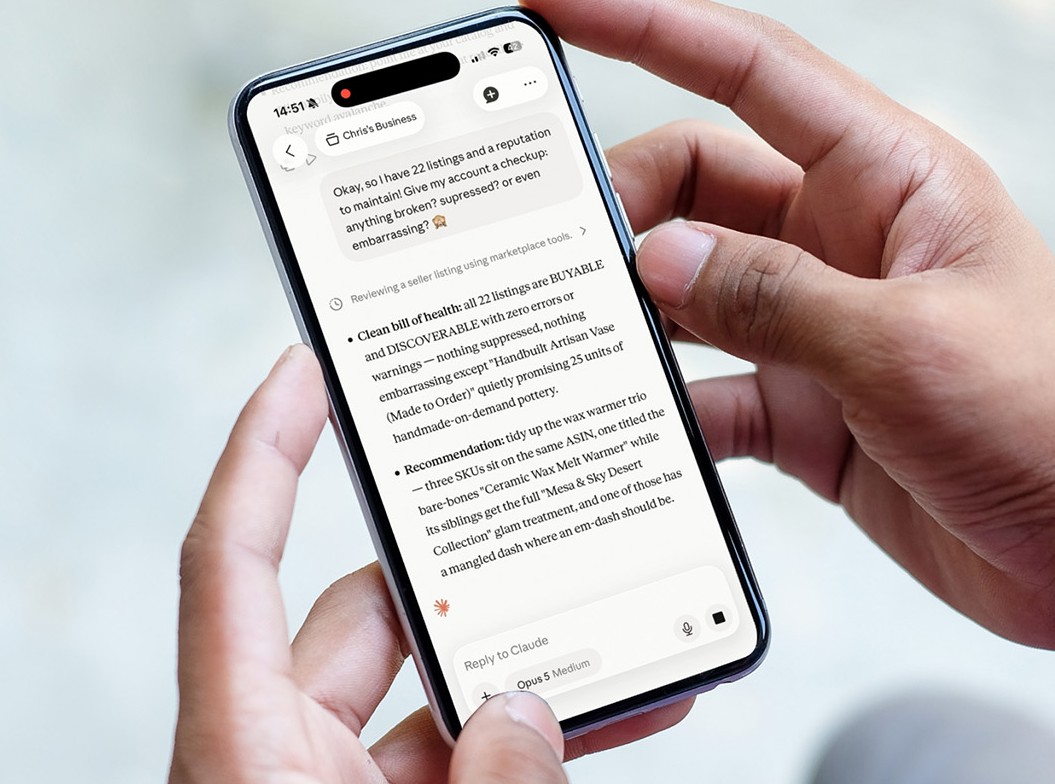
At its Accelerate conference, Amazon says it is opening its seller tools to third-party AI agents, starting with Claude, in beta for US merchants
THE SO WHAT
Opening Seller Central to external agents formalizes Amazon’s marketplace as an API-first, agent-operated environment—whoever controls the agent controls the storefront. If you build seller tools or aggregators, you’re now in a race to become the default agent layer sitting between merchants and Amazon’s primitives.
READ THE SOURCE
MORE FROM THE WIRE
 Applied AI
DeepSeek Tests Efficient, Safer Method for Training AI Agents
If DeepSeek can show agents learning faster with fewer safety issues, the bottleneck shifts from ‘can we train agents?’ to ‘can we verify and govern them at scale?’. Teams experimenting with agentic systems should be budgeting more for evals and oversight frameworks than for raw training cycles.
Applied AIAnthropic Unveils Cheaper Claude Opus 5.5 Ahead of Expected IPO
Claude Opus 5.5 being faster and cheaper ahead of an IPO is another data point that top-tier capability is converging on a price war. If you locked in long-term contracts on older models, revisit your unit economics and be ready to renegotiate or multi-source.
 Applied AI
Thinking Machines signs $65m-a-year inference deal with Crusoe
A $65M-per-year managed inference deal signals that for some labs, outsourcing GPU operations to specialized providers beats owning the stack. If you’re scaling inference beyond a few million a year, it’s time to benchmark managed AI infra — including power-source strategy — against your cloud and on-prem plans.
Applied AIAdvancing Private AI Compute with secure, server-side memory
Google’s push for secure, server-side memory in Private AI Compute is a bet that persistent personalization can coexist with strict data boundaries. If you’re designing assistants with memory, you need a clear stance on where that memory lives, who can query it, and how you’ll prove compliance to auditors.