
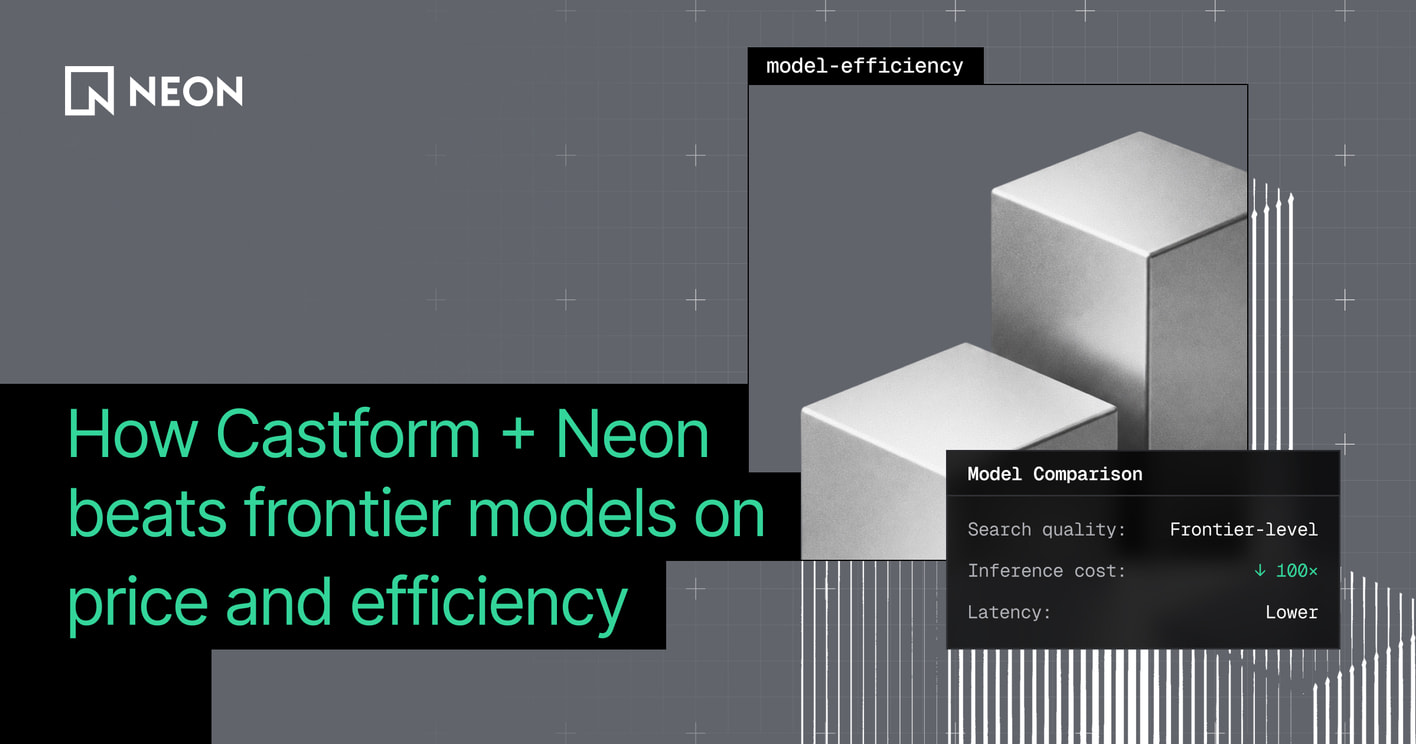
Beating GPT-5.6 Sol on retrieval with 100x cheaper open models
THE SO WHAT
If Neon and Castform can beat a frontier model like GPT-5.6 Sol on retrieval using much cheaper open models, the economic argument for "just call the biggest model" weakens further. For any retrieval-heavy product, you should be benchmarking open stacks against your current frontier spend — and designing architectures that can swap components as price/performance curves move.
READ THE SOURCE
MORE FROM THE WIRE
 Applied AI
Meta launches Muse Code, an AI agent for large code bases
Coding agents that can operate over large, complex codebases shift AI from autocomplete to true maintenance and refactor work. If you own a legacy monolith, the question is no longer “can AI help?” but “what guardrails do we need before we let an agent touch production repos?”
 Applied AI
Prime Agent: A self-improving RLM agent
Self-improving RLM agents move the bottleneck from coding the agent to constraining its learning loop. Before adopting anything like this, teams need a clear policy on what data the agent can learn from and how regressions are detected and rolled back.
 Applied AI
Trump’s DOJ gains oversight of OpenAI’s green-card employee sponsorships
Direct DOJ oversight of one lab’s green-card sponsorships puts a spotlight on immigration as a control lever in AI competition. Any AI-heavy org relying on foreign talent should scenario-plan for slower or more politicized visa processes and build redundancy into critical roles.
 Applied AI
Meta enters the AI coding wars with Muse Spark 1.2 and Muse Code with persistent async background agents
Persistent async coding agents that run in the background turn your codebase into a living system that’s constantly being modified. Before enabling this, teams need hard rules on scope—what the agent can touch without review—and a CI pipeline that can absorb continuous, machine-initiated changes.