

Google has promised to pay $44bn of rent on buildings it will never own
THE SO WHAT
A jump from $6.5bn to $44bn in guaranteed data center lease payments in a quarter is Google turning its balance sheet into a backstop for the AI infra buildout. For operators, the message is clear: hyperscalers are all-in on third-party-owned capacity — your negotiation leverage on long-term pricing and locality will hinge on how critical your workloads are to their utilization math.
READ THE SOURCE
MORE FROM THE WIRE
 Applied AI
He brought AI to Wall Street in 1994 — but won’t trust ChatGPT with his money
When a quant who’s run AI in production for decades won’t let a general-purpose LLM near his portfolio, that’s a signal about domain-specific guardrails, not luddism. If you’re in financial services, treat frontier models as research copilots and UX layers — not as execution engines — until you’ve built and validated narrow, supervised stacks around them.
Tech giants are getting caught in a compute conundrum
When Microsoft’s stock is whipsawed by the same AI compute it’s selling, you’re seeing the limits of “infinite cloud” meet physical capex and power constraints. Operators betting on aggressive AI roadmaps should assume periodic capacity rationing and price volatility — and negotiate SLAs and reserved capacity like a scarce commodity, not a utility.
Applied AIChina Vows Response to US Sanctions Threat Against AI Firms
Threatened US sanctions on Chinese AI firms — and Beijing’s pledge to respond — turn model access and training data into explicit geopolitical levers. Multinationals running cross-border AI programs should be mapping where their model vendors, data flows, and chip supply chains intersect with US–China policy risk, and building fallback options now.
 Applied AI
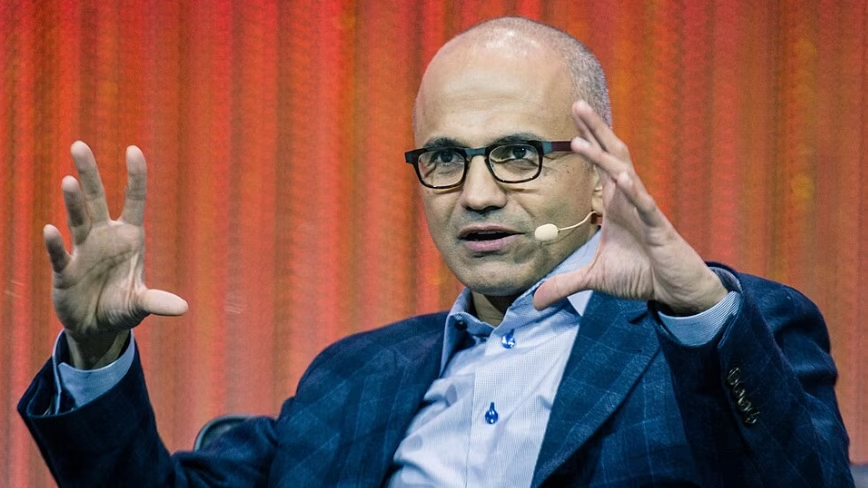
Nadella won’t call it a bubble. He’ll only say how it ends badly.
When Nadella talks about how the AI cycle could “end badly” while simultaneously prioritizing Copilot and custom silicon, he’s acknowledging that the constraint is sustainable economics of compute, not model capability. Operators should be modeling AI projects with explicit assumptions on future compute pricing and availability — and stress-testing what happens if those assumptions break.