

I was buried in email newsletters. Here’s how Claude rescued me
THE SO WHAT
Handing Claude control of a Gmail inbox for triage and drafting shows how quickly users will delegate high-volume, low-judgment communication once trust is earned. For SaaS products that live in email or notifications, assume an AI layer will sit between you and the user—optimize for machine-readable structure and summarizability, not just human eyes.
READ THE SOURCE
MORE FROM THE WIRE
 Applied AI
'The question is no longer whether organisations should adopt AI. It's whether they can explain, govern and trust the AI they've already deployed': Many companies deploying AI often end up with much bigger security issues
AI is now a security surface as much as a productivity tool—unexplained models and shadow deployments are turning into live vulnerabilities. This week, inventory where AI is in production and assign explicit ownership for model behavior, data access, and incident response.
 Applied AI
Understanding cyber resilience in the age of internal threats, AI, and emerging data loss risks
As AI proliferates, the failure mode shifts from perimeter breaches to internal misuse and opaque data flows. CISOs should pair every new AI deployment with explicit data-loss scenarios and recovery drills, not just more monitoring dashboards.
 Applied AI
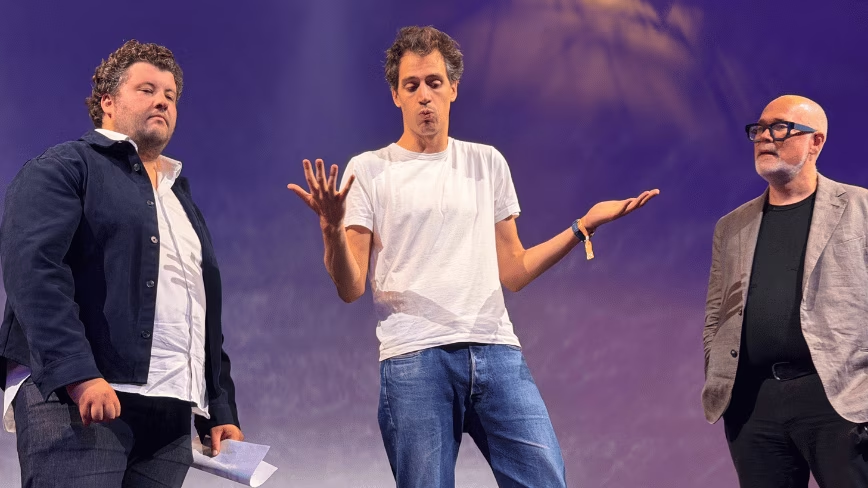
RAISE Summit hit by power outage during keynote with Mozilla president and Mistral CEO
A power outage during an open-source AI reliability talk is an on-the-nose reminder that compute is only as good as the grid behind it. For anyone scaling AI infra, resilience planning needs to include power redundancy and failover, not just multi-cloud.
 Applied AI
Former GitHub CEO Thomas Dohmke's Entire launches a decentralized Git network to handle high coding agent traffic, with servers in the US, the EU, and Australia
A decentralized Git network purpose-built for coding agents is a bet that AI, not humans, will be the primary repo client in a few years. If you’re planning large-scale agentic coding, you now have to think about source control as machine-to-machine infrastructure capacity, not just developer tooling.