
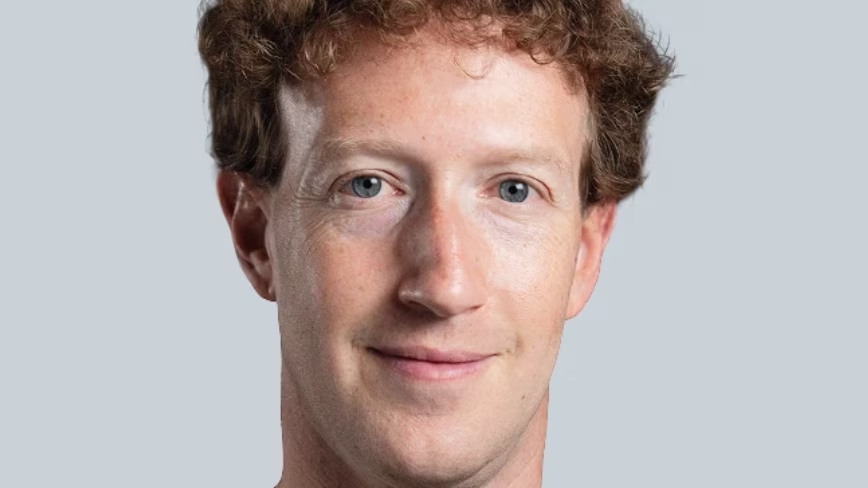
Meta debuts Muse Image, its first AI image model built under Alexandr Wang’s lab
THE SO WHAT
Meta folding Muse Image directly into Meta AI, Instagram, and WhatsApp turns image generation into a default layer of consumer messaging and social, not a separate destination app. If your product depends on creative tooling or UGC funnels, assume your users will have native, one-tap image gen in their chat and feed flows and design around that, not against it.
READ THE SOURCE
MORE FROM THE WIRE
 Applied AI
The real cost, security, and culture problems behind enterprise AI agents
Agentic AI is stalling less on model quality and more on org friction — security, data access, and ownership of failure modes. If your pilots are stuck, treat agents as a cross-functional product with budget, SRE, and risk owners, not a sidecar to the data science team.
 Applied AI
Why the rise of open source AI isn’t hurting Anthropic … yet
Open source and frontier labs are splitting the lifecycle — OSS dominates experimentation and early deployment, closed models capture late-stage scale and compliance. For most teams, the pragmatic path is hybrid: prototype on open weights, standardize on a small set of commercial backbones where risk and uptime matter.
 Applied AI
Microsoft joins AI cost-cutting trend by relying more on its own models
The margin story on AI is shifting from "spend whatever it takes" to "own the stack or bleed." If you're building on third-party models at scale, assume your vendors are under the same pressure and revisit your cost structure and lock-in this quarter.
 Applied AI
Discord admits AI moderation bug wrongfully banned users over harmless images
8,000 wrongful bans from a single AI moderation bug is a reminder that "safety" systems can become the primary failure mode. Any operator deploying automated moderation should treat appeal UX, logging, and rollback as first-class product work, not afterthoughts.