

Meta made its own AI detection system. It should have just used Google’s
THE SO WHAT
Meta’s Content Seal watermarking system—developed after its Oversight Board pushed for in-house tools—shows platforms want first-party control over AI provenance, even if alternatives like SynthID exist. For brands and creators, this means detection standards will fragment by platform, and content ops will need to track multiple labeling regimes.
READ THE SOURCE
MORE FROM THE WIRE
 Applied AI
Source: OpenAI raised its projected cloud spending to ~$750B through 2030, up from a projection of ~$600B earlier this year, reflecting new cloud agreements
A projected ~$750B in cloud spend through 2030 makes AI compute look like a sovereign-scale utility, not a SaaS line item. If your roadmap depends on hyperscaler economics, assume AI capacity will be pre-allocated by a few anchor tenants and lock in long-term commitments or alternative providers sooner than you planned.
Applied AIOpenAI Plans to Spend Over $30 Billion on Georgia Data Center
A single OpenAI data center near Savannah with a price tag north of $30B turns AI infrastructure into one of the largest industrial projects in the region—on par with major fabs or energy plants. For anyone building around AI workloads, this is a cue to factor power, water, and regional policy into your capacity planning, not just GPU availability.
 Applied AI
Building AI infrastructure with the Effingham County community
OpenAI’s Project Camellia in Effingham County — with explicit commitments on energy, jobs, and Codex access — shows hyperscale AI buildouts are now political and community projects, not just data center siting decisions. If you’re planning serious AI infrastructure, expect to negotiate workforce pipelines, power mix, and local benefits as part of the core deal structure.
 Applied AI
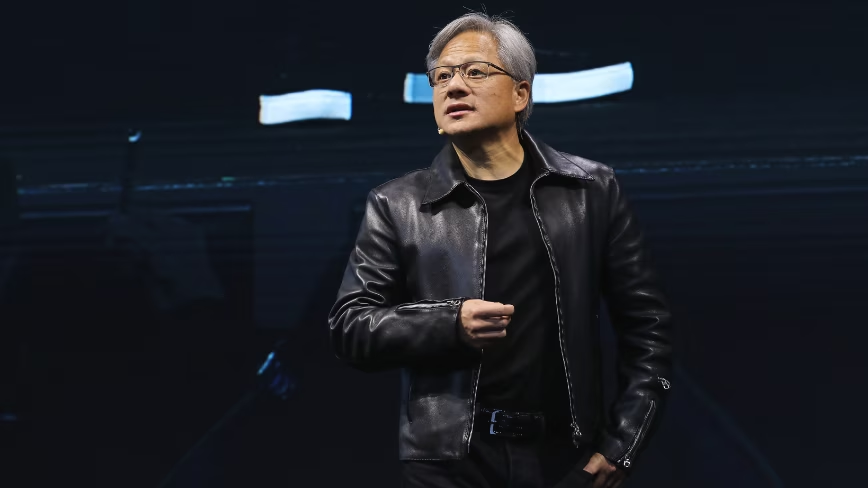
Washington wants to sanction Chinese AI for ‘theft’. Nvidia’s Jensen Huang says that’s backwards.
A US push to scrutinize Chinese open-source models for IP theft—met by Nvidia’s call to keep China in the AI ecosystem—shows export control and model governance are starting to collide. Multinationals building on open models need a clear view of provenance and jurisdictional risk before this hardens into enforceable policy.