

Moonshot plans to list in Hong Kong within six months at a $30 billion valuation
THE SO WHAT
A three-year-old AI startup targeting a $30B Hong Kong listing is a clear signal that public markets in Asia are ready to price frontier-model stories aggressively. If you’re building in that ecosystem, IPO is back on the table as a medium-term path—not just mega-rounds and trade sales.
READ THE SOURCE
MORE FROM THE WIRE
 Startups & Venture
AI Pioneer Kai-Fu Lee’s Startup Targets Hong Kong IPO Next Year
A 2027 Hong Kong IPO target for 01.ai is a marker that Chinese foundation model players see public markets — not just sovereign and strategic capital — as a viable funding path. If you’re building in or selling into China, assume more price and capability competition from domestically financed models rather than relying on Western stack advantages.
Startups & VentureAs companies stay private longer, VC firms, like Spark, Gigafund, and Greenoaks, are investing in companies later on and buying stakes without seeking influence
Late-stage VCs buying passive stakes in companies that stay private longer means more capital with fewer governance strings attached—founders keep control while cap tables get denser. For operators, expect higher valuation pressure and more inside rounds, but less board-driven discipline until much closer to IPO or liquidity.
 Startups & Venture
Netflix bought Ben Afflecks AI startup for $587 million
A $587M AI acquisition by Netflix is a clear tell that core content workflows — scripting, editing, localization, personalization — are moving in-house rather than left to generic tools. Studios, streamers, and large content owners should assume AI-native IP pipelines become a competitive moat and budget accordingly.
 Startups & Venture
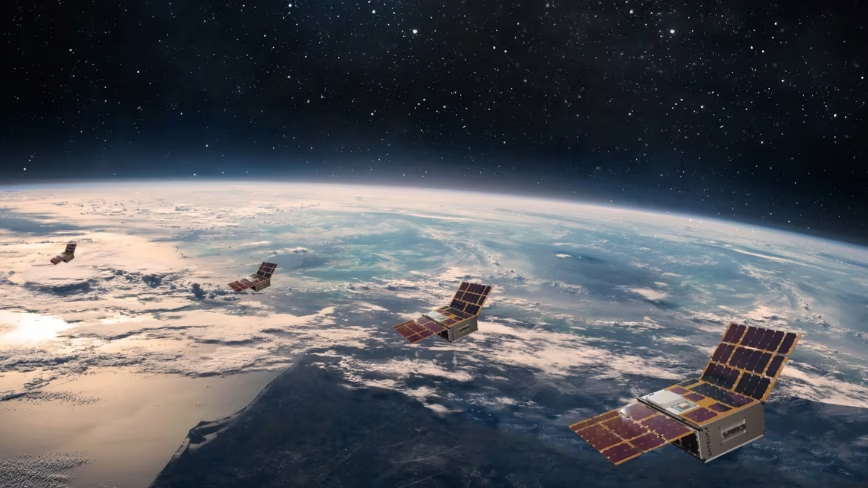
Spanish satellite startup Sateliot wants €150 million to beam 5G directly to smartphones from orbit
Sateliot chasing €150 million to deploy 16 more LEO satellites for direct-to-phone 5G is part of the race to treat space as another cell tower layer. IoT and rural operators should be planning for hybrid terrestrial-orbital connectivity models rather than assuming ground-only networks.