
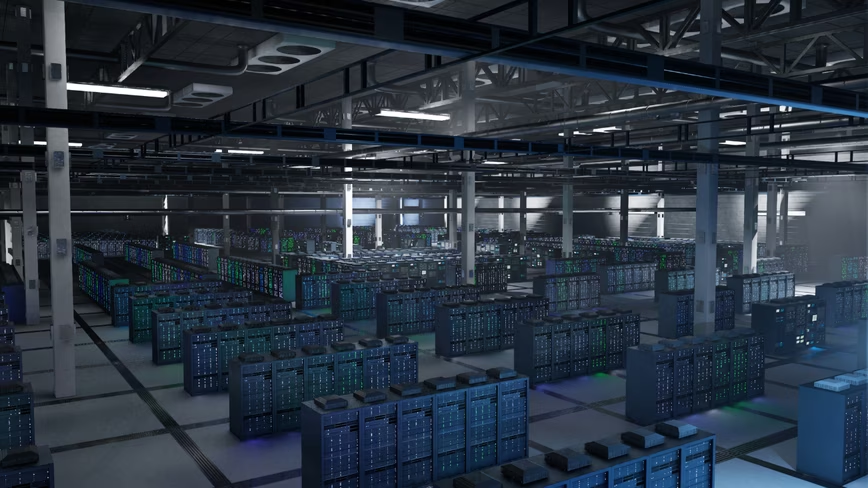
Most Americans don’t want an AI data centre next door. Virginia shows why some say yes
THE SO WHAT
A Redfin poll showing 53% of Americans oppose nearby AI data centers — even as Virginia communities rely on their tax base to fund schools — highlights the emerging NIMBY economics of compute. If you depend on large-scale AI infra, factor local politics and community benefit programs into your site selection as core constraints, not afterthoughts.
READ THE SOURCE
MORE FROM THE WIRE
 Deep & Emerging Tech
Venezuela Oil: Batistas’ Fluxus Clinches Stake in PDVSA Joint Venture
Private capital is tiptoeing back into Venezuela upstream assets despite US sanctions noise—operators with long-cycle energy exposure need a Venezuela scenario in their 10–15 year supply models again. Early signal that political risk tolerance is rising where resource quality is high and Western supply is constrained.
Deep & Emerging TechIntel earnings will pit red-hot AI demand against a sluggish PC market
Intel’s setup—AI data center demand vs. weak PCs—is the same tension most hardware incumbents face: legacy volume funding frontier bets. If your roadmap depends on x86, watch how aggressively Intel reallocates capex and mindshare toward AI; it will show up in pricing, supply, and support for everything else.
 Deep & Emerging Tech
A bizarre new malware campaign hacks your printer and forces it to print out ransomware demands
Printers being hijacked to spew ransom notes is a reminder that ‘boring’ endpoints are still live entry points — misconfigurations, not zero-days, are often the real risk. Inventory and lock down every networked device, not just laptops and servers, before an attacker does it for you.
 Deep & Emerging Tech
Infleqtion Receives Three DOE Genesis Mission Projects for Quantum Computing and Sensing Research
Three DOE Genesis Mission awards to Infleqtion show neutral-atom quantum and sensing are getting real federal backing, not just lab curiosity. If you operate in defense, energy, or critical infrastructure, start tracking where quantum sensing pilots are happening—they may change your threat and detection models on a 3–7 year horizon.