
Sources: China plans to let some of the country's major AI companies buy a small number of Nvidia's H200 chips to alleviate a domestic computing shortage
THE SO WHAT
Allowing limited H200 access to select Chinese AI firms turns compute into an explicitly rationed strategic resource. If you depend on China-based partners or customers for AI workloads, you need contingency plans that assume uneven, policy-driven access to high-end GPUs.
READ THE SOURCE
MORE FROM THE WIRE
 Applied AI
‘In Formula 1, the success goes to the teams that have the best teamwork and the best technology’: I found out how Atlassian is helping Williams F1 be more productive, efficient and collaborative than ever before
When an F1 team attributes measurable effectiveness gains to Atlassian’s AI features, that’s a case study in AI as coordination fabric, not just chatbots. If you’re already on Atlassian, the question this week is which workflows you can safely hand to their AI layer instead of building your own.
 Applied AI
ChatGPT’s ‘smartest voice model ever’ is rolling out to everyone today — and GPT-Live-1 gives you more natural conversations without interruptions
Full rollout of a more natural, interruption-free GPT voice mode turns ChatGPT into a live translation and conversation surface, not just a Q&A tool. Any product that touches calls, meetings, or field work now has to assume customers will expect real-time AI in the loop.
 Applied AI
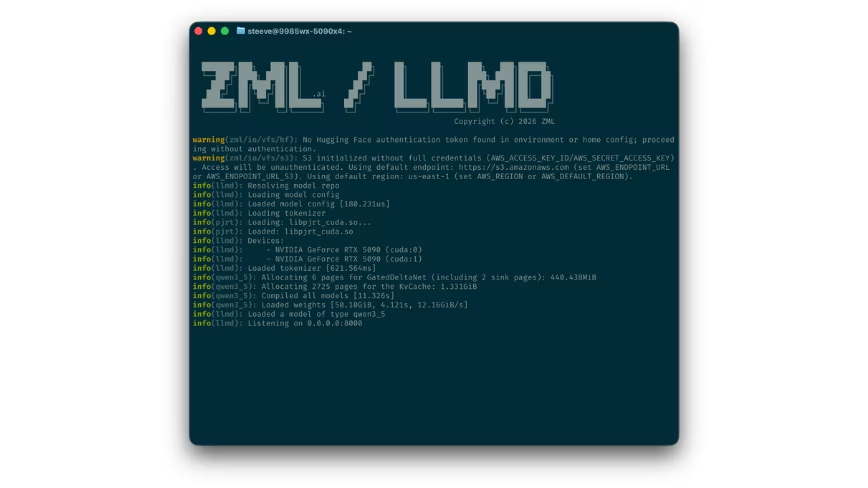
France’s ZML wants to break Nvidia lock-in with free cross-chip AI software
A free inference server that runs open models efficiently across Nvidia, AMD, Google, Apple, and Intel is a direct shot at vendor lock-in at the software layer. If you’re planning GPU spend, start modeling a world where portability and price arbitrage across accelerators are actually practical.
 Applied AI
This ChatGPT prompt turns rambling voice memos into clean to-do lists
Voice-to-LLM workflows that turn messy memos into structured tasks are a quiet wedge into personal productivity stacks. SaaS teams building task or project tools should assume users will increasingly arrive with AI-structured inputs, not raw text.