
Sources: Google told Meta around March it couldn't offer all the Gemini capacity Meta wanted to buy, disrupting and delaying some of Meta's internal AI projects
THE SO WHAT
When Meta can't buy all the Gemini capacity it wants, you know GPU scarcity has moved from vendor marketing line to real execution risk. Any team with material AI roadmaps should be locking in multi‑vendor capacity and on‑prem/hybrid contingencies now—not when your launch window is already slipping.
READ THE SOURCE
MORE FROM THE WIRE
I landed a Big Tech AI job. Treating my career like a science lab helped me overcome my fear of learning AI.
AI hiring is already rewarding people who treat skill acquisition like rapid experimentation, not linear credentialing. For operators, this is a hiring unlock—optimize for people who can run structured experiments with models over people waiting for formal training.
 Applied AI
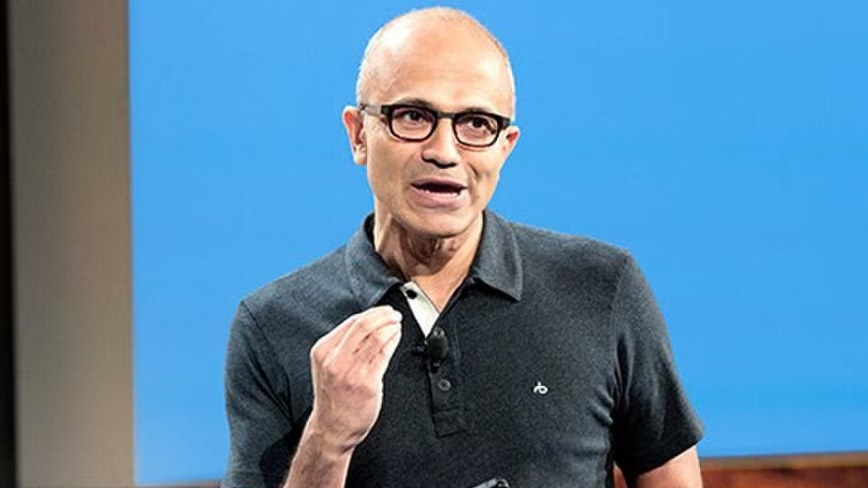
The 33-year-old ex-Snap exec Nadella is trusting to fix Copilot now oversees 11,000 people
Consolidating 11,000 people under a single Copilot leader and killing redundant SKUs is Microsoft treating AI assistants as one product surface, not a bundle of experiments. If you’re still running fragmented AI efforts by function, expect cost and UX pressure as integrated assistants become the norm.
 Applied AI
Google Caps Meta’s Use of Gemini AI, Financial Times Reports
When Google can’t give Meta all the Gemini capacity it wants, compute has clearly crossed into hard-scarcity territory. Any team betting on external frontier models at scale needs contingency plans—multi-vendor, on-prem, or smaller models—baked into 2026 planning.
Applied AIOpenAI Hires Uber’s Prabhjeet Singh to Lead India Operations
Putting a former Uber India president in charge of OpenAI’s fastest-growing market is a distribution move, not a research one. If you operate in India, expect AI assistants to be sold and integrated like ride-hailing once was—through local partnerships, payments, and on-the-ground ops muscle.