
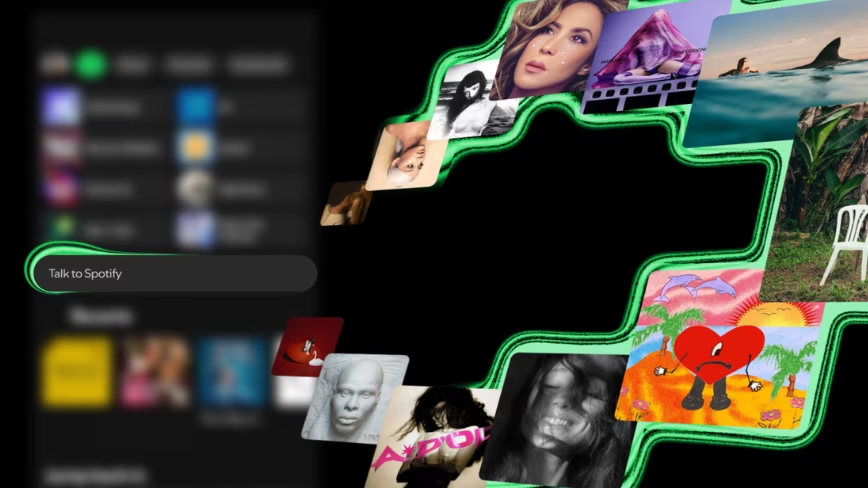
Spotify launches a conversational AI that lets you shape what plays by talking to the app
THE SO WHAT
Spotify’s conversational AI for Premium users turns the player into a dialog surface — “talk to your catalog” is becoming a mainstream pattern. If you run any content or data-heavy product, assume users will expect natural-language control over filters, history, and discovery within 12–18 months.
READ THE SOURCE
MORE FROM THE WIRE
The CEO of a startup helping non-techies code still sees a lot of value in engineering degrees
Low-code that actually works will increase the premium on people who understand systems, not decrease it. If AI can give non-engineers syntax, your differentiator as an engineer becomes architecture, debugging, and owning reliability under load.
 Applied AI
Cohere VP says enterprise AI sovereignty requires control of the full agent stack
Enterprise "AI sovereignty" is shifting from model choice to end-to-end agent stack control — orchestration, tools, data, and runtime. If you're serious about sovereignty, you need a reference architecture for what runs where, who owns which layer, and how you can swap components without breaking workflows.
 Applied AI
Thinking Machines Lab Drops Its First Model
A 975B-parameter open model trained for video and audio is another step toward frontier-grade multimodal capabilities outside closed labs. If you're building on open source, start planning for workloads — surveillance, media, robotics — where multimodal understanding, not just text, becomes your core differentiator.
 Applied AI
Thinking Machines amps up its bet against one-size-fits-all AI with its first open model, Inkling
Thinking Machines is using Inkling as a proof point for a "no one-size-fits-all" thesis — big open multimodal backbone plus domain-specific adaptation. For enterprises, the question shifts from "which model" to "what's our customization surface" — data, tools, and constraints layered on top of a shared base.