

Yesterday's signals, distilled, A look back at June 12, 2026.
SpaceX went public and closed up 19%, and the market immediately treated it less like an aerospace manufacturer and more like a foundational infrastructure asset.
Merger talk with Tesla moved from internet sport to something executives are willing to hint at on-record. Separately, SpaceX’s internal AI compute became a tradable asset, with capacity reportedly leased out when it didn’t fit the in-house stack.
In parallel, the “AI everywhere” narrative took a credibility hit. KPMG retracting an AI benefits report over hallucinated case studies is not a media sideshow. It’s a governance signal, boards and regulators are going to demand provenance, not vibes.
Underneath all of it is a single throughline: the stack is hardening around two control points, physical infrastructure (power, launch, comms, data centers) and workflow surfaces (the super-app consolidation of chat + code). Everything else is becoming a derivative.
The strategic question operators should sit with this week: where are you exposed to someone else’s control point, and what’s your exit if that control point reprices, integrates vertically, or gets regulated?

INFRASTRUCTURE / CAPITAL MARKETS
Space infrastructure is being priced like national compute
SpaceX IPO closes up 19%, and creates the world’s first trillionaire
SpaceX’s IPO closed up 19%, delivering the world’s first trillionaire and marking the largest IPO ever, per TechCrunch.
The immediate market read matters as much as the pop: public investors are underwriting a long-duration, capex-heavy platform with regulatory and geopolitical surface area, not a single product line.
The Bet: Public markets will treat launch + broadband + orbital infrastructure as a durable chokepoint worth paying up for.
So What? This is a financing unlock for “hard” infrastructure narratives across the AI economy, power, cooling, spectrum, logistics, and edge networks. If you’re building anything compute-adjacent, your competitive set just expanded to include public-market-funded balance sheets that can tolerate multi-year build cycles. The second-order effect is talent and supplier gravity, vendors will follow the most bankable capex plans.
The Risk: IPO heat can mask execution constraints, permitting, supply chain, and regulatory friction don’t disappear because the equity is liquid. If macro tightens, the same market that funds infrastructure can also demand near-term margin stories that don’t fit the build.
Action:
- Map which parts of your roadmap depend on third-party infrastructure chokepoints, launch, spectrum, edge connectivity, power, colocation.
- Re-run your 24-month vendor risk model assuming a major partner becomes a public-market operator with different disclosure and pricing incentives.
- If you sell into infrastructure players, tighten your “capex narrative”, procurement will favor vendors that de-risk schedule, not vendors with the best demo.

INDUSTRIAL INTEGRATION / GOVERNANCE
Founder ecosystems are becoming the unit of competition
SpaceX president hints at a Tesla merger
SpaceX president Gwynne Shotwell gave another hint that a Tesla merger could happen, per TechCrunch.
This follows a broader rise in merger chatter as investors and operators model tighter coordination across Musk-led entities, energy, mobility, space, and AI.
The Bet: Integration across capital, talent, and IP will outperform “clean” corporate boundaries in capital-intensive categories.
So What? For operators, the practical shift is not whether a merger closes. It’s that counterparties will increasingly behave like integrated platforms even before the paperwork, shared procurement, shared compute, shared autonomy stacks, shared regulatory strategy. If you’re a supplier, partner, or competitor in any one vertical, you should assume cross-subsidy and cross-leverage across the rest.
The Risk: Integration creates governance and regulatory complexity, and can slow decision velocity if approvals, disclosures, or conflicts multiply. It also increases key-person dependency as the ecosystem tightens around a single coordinating center.
Action:
- Scenario-plan contracts and partnerships under two conditions: “separate entities” vs “integrated platform”, especially around exclusivity, data rights, and pricing.
- Identify where you are single-threaded on a founder ecosystem for supply, distribution, or compute, and line up a second source.
- Update your competitive intel model, track cross-entity hiring, shared facilities, and shared infra as leading indicators, not rumors.
AI INFRA / CAPACITY MARKETS
Compute is becoming leasable real estate, not a sacred internal advantage
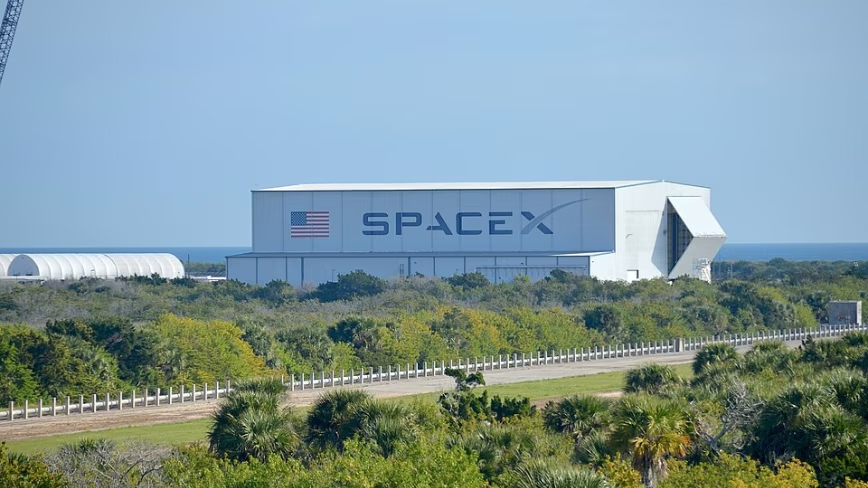
SpaceX reportedly rents “Colossus 1” data center capacity to Anthropic after internal latency issues
Sources say SpaceX decided to rent its Colossus 1 data center to Anthropic after internal teams struggled to use it for Grok development due to latency issues, per Techmeme.
The operational detail is the point: “having compute” is not the same as “having usable compute” for a given training/inference topology.
The Bet: AI infrastructure will develop a secondary market where capacity moves to the highest-fit operator, not the original builder.
So What? This is the maturation of AI infra into a capacity market, where utilization and workload fit drive economics, and where “landlord mode” becomes a rational outcome for teams that overbuilt or misbuilt. For builders, it raises the bar on infra planning: network topology, data gravity, and latency budgets are now financial variables, not just engineering ones.
The Risk: Leasing compute can create hidden dependencies, security posture, compliance boundaries, and operational control get complicated when the facility is optimized for one tenant and repurposed for another. Also, a capacity market can cut both ways, it can lower prices in the short term, then spike when demand concentrates.
Action:
- Audit your latency budget end-to-end, storage, interconnect, and data locality, before you sign or build capacity you can’t actually use.
- Negotiate “exit ramps” in compute commitments, conversion to different instance types, regions, or even subleasing rights where possible.
- Treat infra utilization as a board-level metric, if you’re underutilized, decide early whether you’re optimizing for internal fit or external monetization.

GOVERNANCE / CREDIBILITY
AI claims are becoming a liability surface
KPMG retracts AI benefits report after hallucinated case studies
KPMG retracted a report on AI’s benefits after it was found to exaggerate AI adoption with case studies that appear to have been based on AI hallucinations, per Techmeme.
This is less about one report and more about the standard of evidence for AI claims, especially when those claims influence budgets, policy, or investor decisions.
The Bet: The next phase of AI adoption will be gated by verification and provenance, not model capability.
So What? Expect procurement, boards, and regulators to ask for auditable trails: what was generated, what was verified, and by whom. If you publish AI-driven analysis externally, marketing, research, customer ROI claims, security reports, you’re now operating in an environment where a single provenance failure can become a reputational and legal event.
The Risk: Over-correcting can slow shipping, teams can bury themselves in process theater. The goal is not “no AI in the workflow.” The goal is clear accountability for what’s asserted as fact.
Action:
- Add a hard gate for externally published AI-assisted content, named reviewer, source list, and a retained draft trail.
- Implement a lightweight provenance log for high-stakes outputs, customer claims, financial analysis, compliance artifacts.
- Train GTM and comms teams on “claim hygiene”, what can be said as opinion vs what requires evidence.
CONTRARIAN SIGNAL
The IPO wasn’t the story. The tradability was.
The loud narrative is that SpaceX’s IPO proves public markets will fund hard tech again.
The quieter mechanism is more important: once infrastructure becomes liquid and legible to public investors, it becomes tradable in multiple senses, equity, capacity, partnerships, and political attention. That changes how quickly the ecosystem can reconfigure around it.
The same week that a space infrastructure platform becomes a public-market asset, its data center capacity reportedly becomes a leasable commodity. That’s not a contradiction. It’s the playbook: build the chokepoint, then decide whether you’re an operator, a landlord, or both.
The Takeaway: Liquidity is a capability. If your strategy assumes stable counterparties and static boundaries, you’re planning for a market that’s disappearing.
THE QUESTION FOR TODAY
Public markets are underwriting infrastructure again. Founder ecosystems are integrating across sectors. Compute is turning into a capacity market with real exit options. And AI credibility is shifting from persuasion to proof.
Where do you still have “trust-based dependencies”, on vendors, models, or partners, that you have not converted into contracts, audits, or second sources?
Signal + Noise is strategic intelligence, not engagement-specific advice. For guidance calibrated to your org, start with Advisory.
See exactly how this impacts your specific industry and function. Upgrade to PRO to get bespoke tactical breakdowns generated instantly for your operating model.
Go deeper with the Weekly Signal
This is the daily take. The Weekly goes further — full strategic analysis across 8–10 sections, each with a signal read and operator action items. Source panel included.
Sign up free → then upgrade