
Yesterday's signals, distilled, A look back at July 15, 2026.
Open weights got bigger and more opinionated.
Apple’s AI stack got more jurisdictional, and more transactional. China approval, a local model partner, and a clearer posture on where ads are allowed to show up.
Robotics moved from “can it work” to “who governs the transition.” Labor action in auto manufacturing. Policy positioning from a humanoid vendor. And a practical deployment wedge in last-mile delivery.
Underneath it: control points are fragmenting. Models by deployment environment. AI features by regulator. Automation by labor contract. Ads by category policy.
The strategic question is no longer “what’s the best model” or “when will robots arrive.” It’s where your organization can tolerate fragmentation, and where you need a single global standard because the operational overhead will compound.
CAPABILITY / OPEN MODELS
Open multimodal is becoming a viable enterprise option, with ideology and cost as product features
Thinking Machines Lab releases Inkling, an open multimodal model positioned for low-cost, on-prem use Thinking Machines Lab open-sourced its first multimodal model, Inkling, emphasizing low cost and “resistance to censorship,” explicitly framing it as something teams can run with more control than closed APIs, per VentureBeat. Wired reports Inkling as a 975B-parameter open model trained for video and audio, pushing frontier-grade multimodal capability further into the open ecosystem, per Wired.
This is not a “best model” claim. It’s a control claim.
So What? Open-weight multimodal is now a credible path for teams that care about predictable unit economics, policy stability, and internal data boundaries more than absolute frontier performance. The “resistance to censorship” framing also matters operationally, it’s a signal that model governance will be contested at the model layer, not just at the app layer, and some vendors will compete on how hard they are to steer.
If you run regulated workflows, the question becomes: do you want your compliance posture to depend on a third-party API’s evolving policy, or on your own deployment discipline.
The Risk: Multimodal open weights can expand your attack surface, especially if teams treat “on-prem” as synonymous with “safe.” And the gap between “available weights” and “production-grade evals, tooling, and monitoring” is still where many deployments fail.
Action:
- Inventory which internal workflows require multimodal inputs (images, video, audio) and could justify an on-prem model for cost or governance reasons.
- Stand up a lightweight eval harness this week, latency, hallucination modes, and tool-use reliability, before any team builds agents on top.
- Write a one-page policy on acceptable use and logging for multimodal inputs, especially anything that could include PII or sensitive visual data.
PLATFORMS / SOVEREIGN AI
Apple’s AI strategy is splitting by jurisdiction, and that split will propagate to everyone shipping globally
Apple Intelligence registered in China; Alibaba’s Qwen named as the model China’s cyberspace regulator registered Apple Intelligence for use on iPhones in the country, and Alibaba said the service will use its Qwen model, per Reuters.
This is a clean example of “global product, local model.”
So What? If you ship AI features across borders, assume your stack will fragment, models, safety layers, data residency, and vendor relationships. The operational burden is not just compliance. It’s product parity, QA, incident response, and analytics across multiple model behaviors.
This also creates a new procurement reality: “model choice” becomes a geopolitical dependency, not a pure technical decision.
The Risk: Fragmentation can quietly break your product promises, especially around consistency, explainability, and support. It can also create internal confusion about what data is allowed to flow where, and which vendor terms apply in which market.
Action:
- Map your AI feature set by jurisdiction, where you can keep one global behavior vs where you must accept local variance.
- Add “model substitution” to your incident playbooks, what happens when a region’s model partner changes or a capability is restricted.
- Ask your AI vendors for their localization roadmap in writing, model availability, hosting options, and compliance artifacts by country.
ROBOTICS / LABOR + DEPLOYMENT
Embodied AI is colliding with labor governance, while practical wedges emerge in logistics
Hyundai partial strike over wages, AI, and humanoid robot deployment Hyundai’s South Korea auto workers went on a partial strike tied to wages, AI, and the prospect of deploying a new humanoid robot in factories, per The Wall Street Journal.
This is a shift from “automation as capex” to “automation as negotiated change management.”
So What? Humanoids are now a bargaining-table object. That means timelines will be set as much by labor relations and governance as by technical readiness. For operators, the key is that “pilot” is no longer a neutral word, it can be interpreted as a commitment to workforce restructuring.
If you’re planning humanoid deployment in any unionized or labor-sensitive environment, your critical path may run through stakeholder alignment, not integration.
The Risk: A poorly messaged pilot can trigger resistance that outlasts the technology cycle. And if agreements get written early, they may lock in constraints that make later scaling uneconomic.
Action:
- Document the specific tasks you intend to automate, and the human roles that will remain, before you talk to vendors or internal comms.
- Build a labor-facing narrative that is operationally true: safety, ergonomics, throughput stability, and role evolution, not headcount reduction.
- Add “negotiation time” to your deployment plan, treat it as a first-class dependency alongside integration and safety validation.
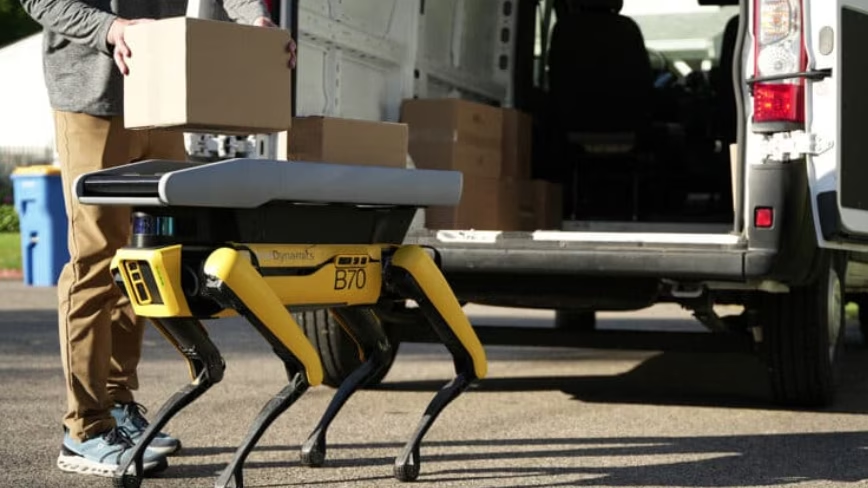
Boston Dynamics tests Spot for van-to-doorstep package delivery Boston Dynamics is testing Spot as a delivery “runner” that walks packages from a van to a doorstep, targeting the last stretch of last-mile delivery, per The Next Web.
This is robotics as a modular add-on, not a full-stack replacement.
So What? The near-term ROI path for delivery robotics may be “driver augmentation” in dense routes, not autonomous vehicles end-to-end. That matters because it changes procurement: you’re buying labor relief and route consistency, not a moonshot autonomy program.
It also changes your data strategy. The valuable dataset is not city-scale driving. It’s curb-to-porch navigation, handoff reliability, and exception handling.
The Risk: The porch gap is where edge cases live, stairs, pets, weather, human interaction. If reliability isn’t high, you risk adding complexity to the driver’s job rather than removing it.
Action:
- Quantify your “porch gap” cost this week, minutes per stop, injury rates, re-delivery rates, and peak-season variability.
- Identify 1–2 routes where augmentation could win, dense, repeatable, low-stair, low-theft environments, and design a pilot with clear abort criteria.
- Require vendors to specify exception-handling workflows, what the driver does when the robot fails, before you sign a trial.
POLICY / HUMANOIDS
Vendors are trying to write the rules early, because the rules will determine deployment speed
Agility publishes six recommendations for U.S. humanoid robot policies Agility outlined six recommendations for U.S. humanoid robot policy, aiming to shape how regulators classify and govern humanoids in industrial settings, per Robotics Business Review.
So What? Humanoid policy is still malleable. The operators who show up with real deployment data, safety incidents, near-misses, uptime, training requirements, will influence whether humanoids are treated like standard industrial equipment or a special category with heavier constraints.
If you plan to deploy, you have leverage now that you won’t have later.
The Risk: Policy written without operator input tends to overfit to worst-case narratives. That can slow deployment even for low-risk use cases.
Action:
- Assign an internal owner for humanoid policy monitoring, not legal in isolation, but ops plus safety plus HR.
- Capture pilot metrics in a regulator-readable format, incidents, mitigations, training time, supervision ratios.
- Join at least one industry working group where these standards are being discussed, or you’ll inherit someone else’s assumptions.
CONTRARIAN SIGNAL
Open weights are not just a technical choice. They’re a governance choice.
The loud story is capability: a huge open multimodal model exists, and more teams can build.
The quieter story is that open weights are becoming a way to opt out of upstream policy drift, and that will attract both legitimate enterprise needs and more adversarial use cases. The result is predictable: more pressure for reporting, thresholds, and compliance regimes that treat “who can run what” as a policy question.
The operators who treat this as purely an engineering decision will get surprised when procurement, security, and legal start asking for controls that look like regulated infrastructure.
The Takeaway: If you adopt open multimodal, you’re not only choosing a model. You’re choosing to own the governance layer that a closed API used to absorb.
THE QUESTION FOR TODAY
Your AI stack is fragmenting by geography. Your automation roadmap is fragmenting by labor governance. Your model strategy is fragmenting by control requirements and cost curves. Your product surfaces are fragmenting by policy and category rules.
Where can you afford fragmentation, and where do you need to force a single standard because the operational overhead will compound?
Signal + Noise is strategic intelligence, not engagement-specific advice. For guidance calibrated to your org, start with Advisory.
See exactly how this impacts your specific industry and function. Upgrade to PRO to get bespoke tactical breakdowns generated instantly for your operating model.
Go deeper with the Weekly Signal
This is the daily take. The Weekly goes further — full strategic analysis across 8–10 sections, each with a signal read and operator action items. Source panel included.
Sign up free → then upgrade