

Yesterday's signals, distilled, A look back at November 5, 2026.
Permitting politics moved from background noise to an explicit constraint.
GPU geopolitics showed up in a less-discussed form, not export controls, but import throttling, with real inventory sitting idle.
And the “assistant” kept expanding into regulated surfaces, finance, identity, and personal data, but with deliberate guardrails that look designed for trust-building before full automation.
Underneath the day’s headlines is a single operational reality: AI scale is now negotiated across three constituencies at once, local communities (data centers), nation-states (chips), and end-users (data access). None of those constituencies moves at software speed.
This is early evidence of a broader shift: the bottleneck is less “model capability” and more “permissioning”, legal permission, political permission, and user permission.
If that’s right, the strategic question for operators becomes simple: where are you assuming frictionless access, to power, to GPUs, to customer data, that no longer exists?
INFRASTRUCTURE / COMPUTE
Data centers are becoming brownfield projects and political projects
Nvidia / Apollo, Retrofitting 130+ legacy telecom buildings into small data centers
Nvidia reportedly approached Apollo about converting some of the 130+ buildings owned by Brightspeed, a struggling ISP controlled by Apollo, into a network of small data centers, per The Information.
This is a different answer to the same constraint the market keeps surfacing: greenfield hyperscale capacity is colliding with permitting timelines, grid interconnect queues, and community pushback.
The Bet: Distributed, brownfield compute can be stood up faster, and with less political resistance, than new mega-campuses.
So What? If this pattern holds, “data center strategy” starts to look like real estate strategy: site control, entitlements, fiber adjacency, and upgrade economics become first-order variables. For operators, the implication is not that you should build your own micro-DC network. It’s that your capacity plan may increasingly depend on non-traditional inventory, retrofits, edge colo, and incremental expansions, rather than a clean hyperscaler roadmap.
It also changes vendor conversations. A provider that can only sell you capacity in a handful of contested metros is a different risk profile than one with a credible brownfield pipeline.
The Risk: Small sites can be power-constrained, operationally complex, and expensive to standardize, especially if they weren’t designed for modern cooling, security, or high-density racks. A “mesh” can become a reliability and staffing problem if it’s not engineered like a product.
Action:
- Inventory where your critical workloads run, then map the physical campus and entitlement status behind the SKU you think you’re buying.
- Ask colocation and cloud partners which expansions are already permitted versus speculative, and what MW and delivery dates are contractable.
- Add a brownfield option to your 2027 capacity plan, even if it’s a contingency, document the trigger conditions.
Meta, US data center permitting gets harder; expansions get easier
Meta President Dina Powell McCormick said building new US data centers will be harder after the midterm results, while expanding existing projects will be easier, per The Wall Street Journal. Tech coverage framed this as election backlash turning data centers into a local political issue, via TechCrunch.
The nuance matters: the constraint isn’t “no more data centers.” It’s “fewer new sites, more incremental buildout where the footprint already exists.”
The Bet: Incumbency, existing campuses with grid access, becomes a durable advantage in US capacity.
So What? This pushes the market toward consolidation around already-entitled land and already-negotiated community relationships. For enterprise operators, it means your “region strategy” may be decided for you by where your providers can actually expand. Latency, data residency, and disaster recovery planning now have to incorporate political feasibility, not just technical preference.
It also raises the value of demand-shaping. If expansions are easier than new builds, providers will prioritize customers who can commit to steady load profiles, flexible scheduling, and longer-term contracts, because those customers help justify expansion approvals and grid negotiations.
The Risk: Expansions can still hit hard constraints, transformer lead times, water availability, and interconnect delays don’t disappear because zoning is friendlier. And political sentiment can swing quickly if local impacts (noise, traffic, water) are mishandled.
Action:
- Re-score your top 3 deployment regions using non-technical constraints, permitting climate, grid queue congestion, and community opposition history.
- Negotiate for optionality, contract clauses that allow region substitution if a campus expansion slips.
- Build an internal “load story”, forecasted MW, ramp schedule, and mitigation plan, so you can be a preferred customer when capacity is rationed.

GEOPOLITICS / SUPPLY CHAIN
Compute constraints now run both directions
Nvidia, ~600,000 H200s reportedly stored in Hong Kong awaiting China import approval
Reuters reported that about 600,000 of Nvidia’s H200 chips are stored in Hong Kong awaiting shipment to mainland China, as Beijing withholds approval for large-scale imports, per Reuters.
This is the mirror image of the export-control story the market is used to. Import approvals become a throttle, and inventory can sit in limbo even when it’s already “in the region.”
So What? For any operator with China exposure, customers, R&D, joint ventures, or regional inference, the planning assumption “GPUs will arrive if we can pay” is no longer safe. Timelines become political. That pushes architecture toward hedges: multi-region failover, model distillation strategies that can run on less-constrained hardware, and clearer separation between “frontier training” and “regional serving.”
It also changes procurement posture. If approvals can stall at the border, the risk isn’t only price volatility, it’s utilization volatility. You can have capital committed and teams staffed while the hardware sits idle.
The Risk: The reported figure is large, but the operational impact depends on how long approvals are delayed and what categories of imports are affected. This could be a temporary administrative slowdown rather than a durable policy shift, worth monitoring before rewriting strategy.
Action:
- Downgrade any plan that assumes predictable frontier GPU delivery into mainland China, and document the dependency explicitly.
- Design a “degraded mode” serving plan, smaller models, quantization, or alternative accelerators, for China-region workloads.
- Pressure-test contracts for delivery and acceptance terms, clarify who bears the cost of border delays and storage.
ASSISTANTS / TRUST SURFACES
The assistant is becoming a read layer before it becomes a write layer
Anthropic, Claude Personal Finance beta uses read-only Plaid access
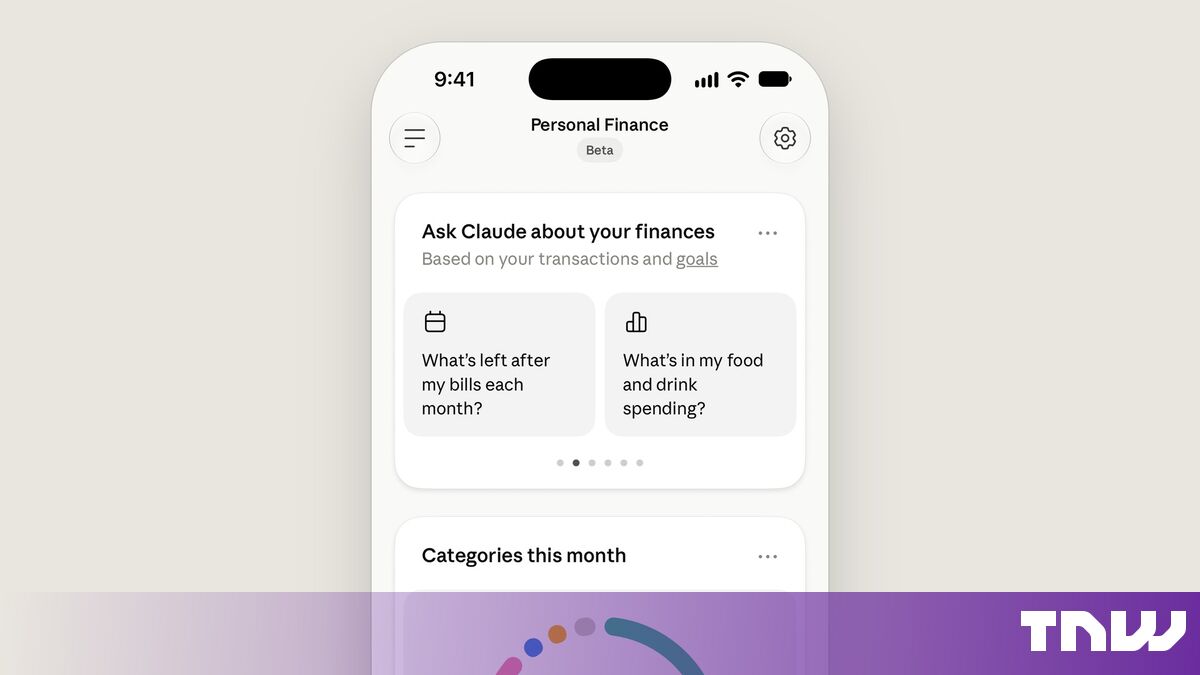
Anthropic launched a Personal Finance beta that lets Claude read bank account data via Plaid, but not move money, per The Next Web.
The product choice is the point: read-only, no transaction execution. That’s a trust-building posture, and it’s also a regulatory posture.
The Bet: The winning path into finance is “insight first,” with execution gated behind explicit controls and liability frameworks.
So What? This is a blueprint other assistants will follow: start as a cross-account lens, then earn the right to become an operator. For banks and fintechs, the immediate implication is competitive surface area. If a third-party assistant becomes the default interface for “what’s going on with my money,” your app becomes a backend, even if you still own the account relationship.
For operators building assistants into regulated workflows, the pattern generalizes: the fastest adoption path is often read access plus high-quality summarization, anomaly detection, and planning, not autonomous action. “Write” privileges will be the monetization moment, but also the compliance moment.
The Risk: Read-only still carries meaningful risk: data leakage, misinterpretation, and user over-trust. If the assistant is wrong with confidence, the downstream harm can be real even without money movement.
Action:
- Decide your posture: integrate assistants as a channel, or treat them as competitors, then align product and partnership accordingly.
- Audit what “read access” would expose in your systems, and implement least-privilege scopes before you ship any connector.
- Build a human-auditable trail, what data was accessed, what was inferred, and what was shown, as if disputes are inevitable.

CAPITAL FLOWS / MARKET STRUCTURE
Vertical integration is back on the public-markets test bench
Wonder, Confidential IPO filing after $650M Grubhub acquisition and $9B pre-money raise
Wonder confidentially filed for a US IPO, after acquiring Grubhub for $650M in 2025 and raising $650M at a $9B pre-money valuation in July, per Reuters. Tech coverage framed it as a test of the company’s next phase, per TechCrunch.
This is a referendum on a specific operating model: own demand, own kitchens, own logistics, and argue that the unit economics are defensible at scale.
So What? If public investors reward this structure, it will pull capital toward “full-stack” plays in other local services where marketplaces have struggled with margin and quality control. For operators, the near-term implication is competitive tempo: more M&A-heavy rollups, more exclusivity deals for supply, and more pressure to control fulfillment capacity rather than rent it.
Even if you’re not in food, the pattern matters. The market is re-testing whether vertical integration is the antidote to commoditized distribution, and whether operational complexity is now financeable again.
The Risk: IPO filings don’t equal IPO outcomes. The pricing and demand will determine whether this becomes a template or a cautionary tale. And vertical integration can hide fragility, fixed costs don’t forgive demand shocks.
Action:
- Benchmark your unit economics against a “full-stack competitor” scenario, assume they can subsidize acquisition with operational margin.
- Identify the two assets in your chain you cannot afford to rent long-term, then explore ownership, long leases, or exclusivity.
- Monitor the S-1 when it lands, look for disclosure on contribution margin by cohort and the true cost of capacity buildout.
CONTRARIAN SIGNAL
The real constraint isn’t compute. It’s consent.
The day’s stories look like three separate threads: data centers, chips, and assistants.
They’re the same thread.
Retrofitting telecom buildings into data centers is a search for local consent, permits, grid access, community tolerance. Chips stuck in Hong Kong are a search for state consent, import approvals, policy timing, geopolitical leverage. Read-only finance assistants are a search for user and regulator consent, access without action, insight without liability.
The organizations that scale next won’t just be the ones with better models or cheaper inference. They’ll be the ones that can reliably secure permission, and prove they deserve it, across jurisdictions and stakeholders.
The Takeaway: Treat “permissioning” as a first-class dependency in your roadmap. If you can’t explain how you’ll earn and keep consent, your plan is not a plan.
THE QUESTION FOR TODAY
Permitting is tightening while expansions get easier. GPU supply can be throttled after purchase, not just before. Assistants are moving into regulated data surfaces through read-only footholds. Vertical integration is heading back to the public markets for a pricing verdict.
Where is your strategy still assuming frictionless access, to power, to chips, or to customer data, and what is your fallback when that access becomes conditional?
Signal + Noise is strategic intelligence, not engagement-specific advice. For guidance calibrated to your org, start with Advisory.
See exactly how this impacts your specific industry and function. Upgrade to PRO to get bespoke tactical breakdowns generated instantly for your operating model.
Go deeper with the Weekly Signal
This is the daily take. The Weekly goes further — full strategic analysis across 8–10 sections, each with a signal read and operator action items. Source panel included.
Sign up free → then upgrade