
Yesterday's signals, distilled, A look back at November 10, 2026.
Revenue snapped back at the top of the stack. OpenAI told investors Q3 revenue rose 50% to around $10B.
Compute got more contractual. Anthropic’s updated S-1 disclosed another ~$10B in cloud commitments through 2033, plus a reminder that even “alternative” capacity is governed by delivery clauses and cancellation rights.
The work surface kept shifting. Anthropic moved from “model provider” toward “daily canvas” with Claude-powered office tools, while OpenAI pushed ChatGPT further into a branded business surface with claimed profiles and business-run agents.
And the supply chain stayed political. Microsoft and others reportedly lobbied to halt an FCC plan to ban imports of Chinese optical transceivers, an unglamorous component that becomes existential when you’re wiring AI-scale data centers.
The throughline is not “AI adoption.” It’s bargaining power.
When growth re-accelerates, long-dated capacity gets locked, and the interface becomes a distribution layer, operators lose the luxury of treating model access, cloud capacity, and workflow surfaces as separable decisions.
The strategic question to carry into this week: where are you implicitly single-sourcing leverage, compute, interface, or identity, and what’s your exit ramp if pricing or policy moves against you?
CAPITAL FLOWS / PLATFORM ECONOMICS
Frontier labs are behaving like hyperscalers, revenue acceleration on one side, multi-year capacity pre-buys on the other
OpenAI revenue jumps to around $10B in Q3
OpenAI told investors its revenue rose 50% to around $10B in Q3, up from 17% growth in Q2, per The Information.
The key detail isn’t just the number. It’s the re-acceleration, coming after a slower growth quarter, suggesting demand is still elastic at the high end when price-performance and packaging line up.
So What? For operators, this is a reminder that “LLM commoditization” is uneven. Peripheral tooling may compress, but core model access, especially for higher-end reasoning, enterprise controls, and reliability, still carries vendor leverage when demand is strong. If your 2027 plan assumes falling unit costs will automatically offset rising usage, you’re making a bet on vendor pricing discipline that the market hasn’t earned yet.
This also tightens the loop between product roadmap and procurement. When the platform’s revenue engine is working, you should expect faster iteration on monetization surfaces, agents, business profiles, distribution partnerships, because the incentive is to capture workflow adjacency, not just tokens.
The Risk: Investor-reported numbers can reflect packaging changes as much as underlying usage. If growth is being driven by a small number of very large enterprise commitments, the broader market may still be cost-sensitive and churn-prone.
Action:
- Reforecast 2027 AI spend using three scenarios, flat, +25%, +50% effective price per “successful task”, not just per-token pricing.
- Negotiate reliability and rate-limit terms as first-class contract items, treat them like uptime and bandwidth, not “developer experience.”
- Document your model exit ramp, what breaks, what rewrites, what data migrates, before renewal windows, not during them.
INFRASTRUCTURE / COMPUTE PROCUREMENT
Capacity is no longer “available.” It’s contracted, conditional, and increasingly multi-counterparty
Anthropic discloses ~$10B more in cloud commitments through 2033; Lambda deal includes cancellation option
Anthropic’s updated S-1 disclosed it committed roughly $10B more to Microsoft and Google cloud through 2033, and that it can cancel a $34.9B Lambda deal over a delay, though it doesn’t currently plan to, per The Information.
Two things are happening at once: deeper hyperscaler entanglement, and explicit contractual language around delivery risk for non-hyperscaler capacity.
The Bet: Multi-year compute commitments are cheaper than spot scarcity, if you can actually get the capacity delivered on time.
So What? This is what “infrastructure-grade AI” looks like in practice: long-dated obligations, multi-vendor hedging, and legal mechanisms that treat compute delivery like industrial equipment delivery. If you’re an enterprise buyer, the implication is uncomfortable but actionable: your vendors’ capacity posture will increasingly shape your product timelines. The question is no longer “which model is best,” it’s “which provider can guarantee priority when everyone else is also scaling.”
It also changes how to read vendor roadmaps. When a lab is locked into specific clouds through 2033, integration depth with those ecosystems is not an accident. Expect more first-party primitives, identity, data connectors, governance hooks, that make the “best model” decision inseparable from the “best cloud” decision.
The Risk: Commitments can become constraints. If performance-per-dollar shifts faster than contracts, or if a provider’s reliability lags, you can end up paying for capacity that doesn’t map cleanly to your needs. Cancellation rights help, but they don’t eliminate switching costs, especially when data gravity and workflow integration have already set.
Action:
- Ask your top AI vendors one question in writing: “What is your guaranteed capacity and priority mechanism under peak demand, and what are the carve-outs?”
- Map your critical workflows to capacity dependencies, model, region, cloud, and network, so you know where a single failure mode can stall delivery.
- Build a “compute contingency” plan for Q1–Q2 2027 launches, fallback models, degraded modes, and budget headroom for burst pricing.
WORK SURFACES / DISTRIBUTION
The assistant is becoming the canvas, and the canvas is becoming a marketplace
Anthropic unveils Claude-powered office tools ahead of IPO
Anthropic unveiled Claude-powered office tools ahead of its IPO, per Bloomberg.
The product framing matters: this is not just “Claude inside Office.” It’s Claude as the place structured work happens, spreadsheets, meetings, whiteboards, where the model can observe context and influence decisions.
So What? For operators, the work-surface battle is a governance battle. Whoever owns the canvas gets default access to context, permissions, and the “last mile” of execution. If your organization has been treating model selection as a platform-agnostic API choice, this is the week to revisit that assumption. The surface layer is where lock-in becomes behavioral: templates, collaboration norms, and institutional memory.
This also creates a new procurement pattern. You may soon be buying “office tools” that are, structurally, model subscriptions with workflow wrappers. That changes how you evaluate risk: not just data security and compliance, but continuity of operations if the model provider changes terms, throttles, or deprecates features.
The Risk: Parallel canvases create fragmentation. If teams adopt assistant-native sheets/meetings/whiteboards outside the sanctioned productivity stack, you can end up with shadow workflows that are hard to audit, retain, or e-discover.
Action:
- Inventory where “structured work” actually lives today, Excel/Sheets, BI tools, planning systems, and identify which teams are most likely to defect to assistant-native canvases.
- Set a policy for what data classes can enter assistant-native office tools, finance close, HR, regulated data, before pilots spread organically.
- Require integration answers in vendor evals: identity (SSO), retention, e-discovery, and export formats, no exceptions for “early access.”
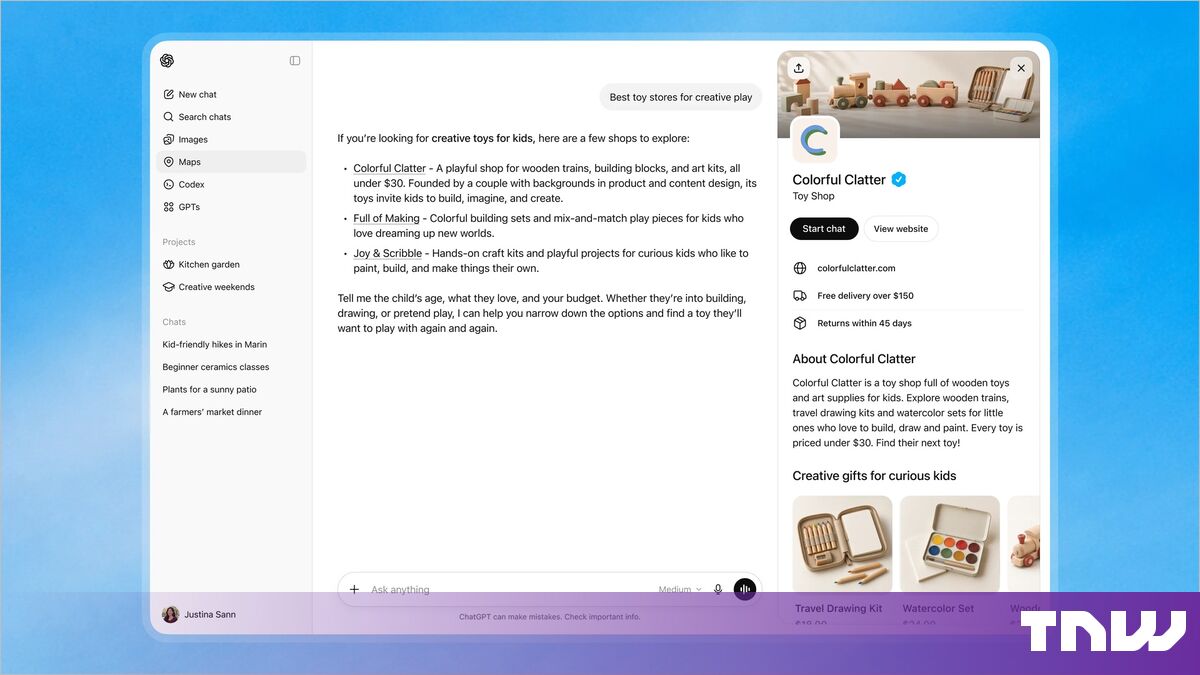
OpenAI lets businesses claim ChatGPT profiles and launch their own agents
OpenAI is letting businesses claim ChatGPT profiles and launch their own agents, per The Next Web.
This is a distribution move. ChatGPT becomes an intent surface where customers ask questions, compare options, and increasingly transact, while brands are pushed to show up with an official presence.
So What? If you run a consumer brand, a marketplace, or any high-consideration product, this is the new “search box” problem, except the answer is conversational, synthesized, and can route to an agent you control or one you don’t. The operational shift is that brand, support, and sales now share a single interface. Your agent’s behavior becomes part of your reputation layer.
For B2B operators, the same mechanism shows up as procurement enablement. Buyers will ask the assistant to evaluate vendors, draft RFPs, and summarize security postures. If your official ChatGPT presence is absent or stale, you’re letting the model fill in the gaps from whatever it can infer.
The Risk: This can turn into an impersonation and policy problem fast, unclaimed profiles, unofficial agents, or “helpful” automations that make commitments your company can’t honor. The reputational blast radius is larger than a bad ad campaign because it looks like customer support.
Action:
- Claim your business profile and define an escalation path, what the agent can resolve, what it must hand off, and how it logs interactions.
- Write a “model-facing” knowledge base, pricing, policies, warranty, security statements, optimized for assistant retrieval and citation.
- Red-team your agent for brand and legal failure modes, refund promises, medical/financial claims, and competitor comparisons.
INFRASTRUCTURE / SUPPLY CHAIN POLICY
AI-scale data centers are now exposed to component-level trade policy
Microsoft lobbies to halt expected ban on Chinese optical transceivers
Microsoft is among companies lobbying the Trump administration to halt the FCC’s plan to ban imports of Chinese optical transceivers, per Reuters.
Optical transceivers are not a headline component. They are, however, a throughput constraint. If you can’t source them at scale, you can’t light up the network fabric that makes GPU clusters usable.
So What? This is permissioning pressure showing up in the bill of materials. Operators tend to model AI infrastructure risk around GPUs, power, and real estate. Optics is the quiet fourth leg. If policy constrains supply, the impact is not “slightly higher costs.” It’s deployment delays, partial builds, and stranded capacity.
For enterprises, the second-order effect is vendor reliability. If your cloud or AI provider is exposed to optics supply shocks, you may see regional capacity limits, slower rollouts of new instance types, or higher network egress costs as providers manage scarcity.
The Risk: Even if a ban is delayed or narrowed, the uncertainty itself can trigger hoarding, price spikes, and procurement lead-time blowouts. Policy volatility becomes operational volatility.
Action:
- Ask your infra vendors where optics sit in their critical path, lead times, supplier concentration, and substitution options.
- Add “network fabric components” to your risk register alongside GPUs and power, optics, switches, and cabling.
- If you run private AI clusters, pre-qualify at least two optics suppliers and validate interoperability now, not during a shortage.
CONTRARIAN SIGNAL
The office suite isn’t being disrupted by “better tools.” It’s being repriced by context ownership.
The loud story is feature competition: Claude tools versus Office, business agents versus websites, assistants everywhere.
The quieter mechanism is context capture.
When the canvas is assistant-native, the model sees the work as it’s created, inputs, intermediate drafts, decisions, and exceptions. That context is more valuable than the final document. It improves the model’s usefulness, increases switching costs, and creates a natural place to insert monetization, premium reasoning, compliance tiers, agent marketplaces.
This is why the surface war matters even if you don’t believe any single tool will “replace” Office this year. The prize is not the spreadsheet. It’s the default place where intent is expressed.
The Takeaway: Treat assistant-native canvases as strategic infrastructure. If you don’t set governance and exit ramps early, you’ll inherit them later under pricing pressure.
THE QUESTION FOR TODAY
Revenue is accelerating at the model layer. Compute is being locked up through 2033. The assistant is becoming the interface where customers and employees express intent. And the physical supply chain is still subject to policy shocks at the component level. None of these are abstract trends. They show up as contract terms, workflow defaults, and delivery risk.
Where are you currently “single-sourcing leverage” without admitting it, model access, cloud capacity, or the work surface your teams live in?
Signal + Noise is strategic intelligence, not engagement-specific advice. For guidance calibrated to your org, start with Advisory.
See exactly how this impacts your specific industry and function. Upgrade to PRO to get bespoke tactical breakdowns generated instantly for your operating model.
Go deeper with the Weekly Signal
This is the daily take. The Weekly goes further — full strategic analysis across 8–10 sections, each with a signal read and operator action items. Source panel included.
Sign up free → then upgrade