

2026.29: Mainframes and Main Characters
THE SO WHAT
If “the end of the mainframe” and “continuing adventures of OpenAI” are in the same roundup, the throughline is consolidation of compute and narrative power into a few platforms. CIOs should be mapping which of their workloads can be decoupled from single-vendor gravity before the next lock-in cycle hardens.
READ THE SOURCE
MORE FROM THE WIRE
 Tech & Innovation
Samsung Galaxy Z Fold 8 Ultra appears online with Messis face and a $13,000 price tag
A $13,000 Messi-branded Fold 8 Ultra from Caviar is a reminder that the real margin in mature phone categories sits in status, not silicon. If you’re in premium hardware, your pricing power is increasingly a function of brand, narrative, and scarcity mechanics, not spec sheets.
 Tech & Innovation
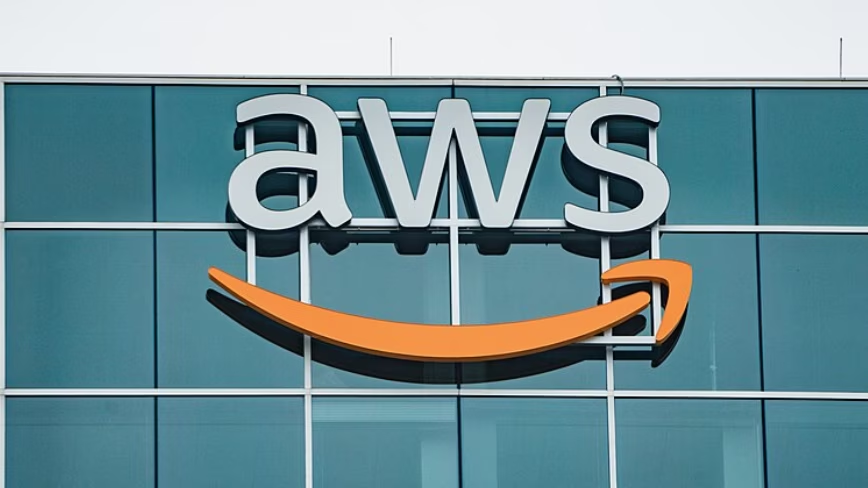
An AWS billing bug sent users estimated charges of up to $2.5 trillion
A unit-pricing bug that spits out $2.5 trillion estimates is a stress test for trust in cloud metering, not just a funny screenshot. If your product depends on usage-based pricing, treat billing accuracy and alerting UX as core reliability work, not back-office plumbing.
 Tech & Innovation
Apple’s plot to crush OpenAI
Whatever the legal outcome, a very public Apple–OpenAI fight normalizes heavyweight platform owners using IP law as a strategic lever in the AI stack. If your roadmap depends on tight integration with either side, assume more contractual and legal friction, not less, over the next few years.
 Tech & Innovation
MacBook Neo vs. XPS 13: The golden age of ultraportables is here
Ultraportables are now a solved hardware category—your differentiation as a builder will live in software, battery-aware workloads, and ecosystem lock-in, not raw specs. Treat these machines as the new baseline client for AI-heavy apps and assume your users will have “good enough” local compute by default.