

Yesterday's signals, distilled, A look back at November 13, 2026.
Wallets shipped. Outages lingered. Export controls leaked.
OpenAI didn’t just add another feature to ChatGPT. It put a payments instrument inside the assistant and framed it as a safer way for agents to transact. That’s a product move, but it’s also a governance move, it formalizes who is allowed to spend, under what constraints, with what audit trail.
At the same time, Microsoft’s productivity stack reminded everyone what “platform dependency” actually feels like when it breaks. A 12+ hour outage isn’t a bad day for IT. It’s a business continuity event, and it exposes how many incident playbooks still assume the collaboration layer is available to coordinate the response.
Underneath both: permissioning is becoming the control plane. Who can execute. Who can ship. Who can buy compute. Who can route around marketplaces. Who can’t.
And the hardware layer stayed political. Reporting tied leading Chinese model training to export-banned Nvidia chips, while U.S. agencies reportedly pointed fingers at each other over enforcement. That combination doesn’t just create headlines. It creates policy whiplash risk for anyone whose roadmap assumes stable access to top-tier accelerators.
The strategic question operators should sit with this week: where are you implicitly trusting a third party to execute on your behalf, money, work, or compute, without a fallback path you’ve actually tested?
COMMERCE / AGENTS
The assistant becomes a checkout actor
OpenAI, ChatGPT Wallet launches with agent purchasing
OpenAI launched ChatGPT Wallet, positioning it as a way for ChatGPT agents to make purchases using user-approved cards without exposing card details to the agent itself, per OpenAI News. The release frames Wallet as an execution layer for agents across ChatGPT experiences, moving from “recommend” to “transact.”
This is the cleanest line yet from assistant-as-interface to assistant-as-operator. It’s also a new liability surface: disputes, returns, fraud, and “who approved what” become first-order product requirements, not edge cases.
The Bet: Users will delegate spend if the wallet layer can make delegation feel bounded, reversible, and auditable.
So What? Agentic commerce is now a distribution channel, not a demo. If ChatGPT becomes a common initiation point for purchases, merchants and consumer apps will feel pressure to optimize for machine customers: structured product data, predictable inventory semantics, clear policies, and fast exception handling. The wallet owner also becomes a new gatekeeper, not by blocking access, but by shaping default flows: which merchants are “safe,” which SKUs are “eligible,” what gets confirmed, and what gets auto-executed.
For fintech and payments teams, the key shift is architectural. The primary integration point may move from “card in browser checkout” to “payment intent from an agent wallet”, with different fraud signals, different authentication moments, and a different dispute narrative.
The Risk: Adoption could be slower than the product implies, users may delegate research but not execution. And if early incidents cluster (fraud, mis-buys, chargebacks), the category could get constrained by conservative defaults that reduce utility.
Action:
- Instrument your funnel for agent traffic now, detect automated browsing and measure conversion, return rates, and support load separately.
- Publish machine-readable policies (returns, cancellations, substitutions) and make them unambiguous, ambiguity becomes agent failure.
- Write an “agent purchase incident” runbook, spend limits, confirmation steps, dispute handling, and customer support scripts.
INFRASTRUCTURE / RELIABILITY
Collaboration is a single point of failure
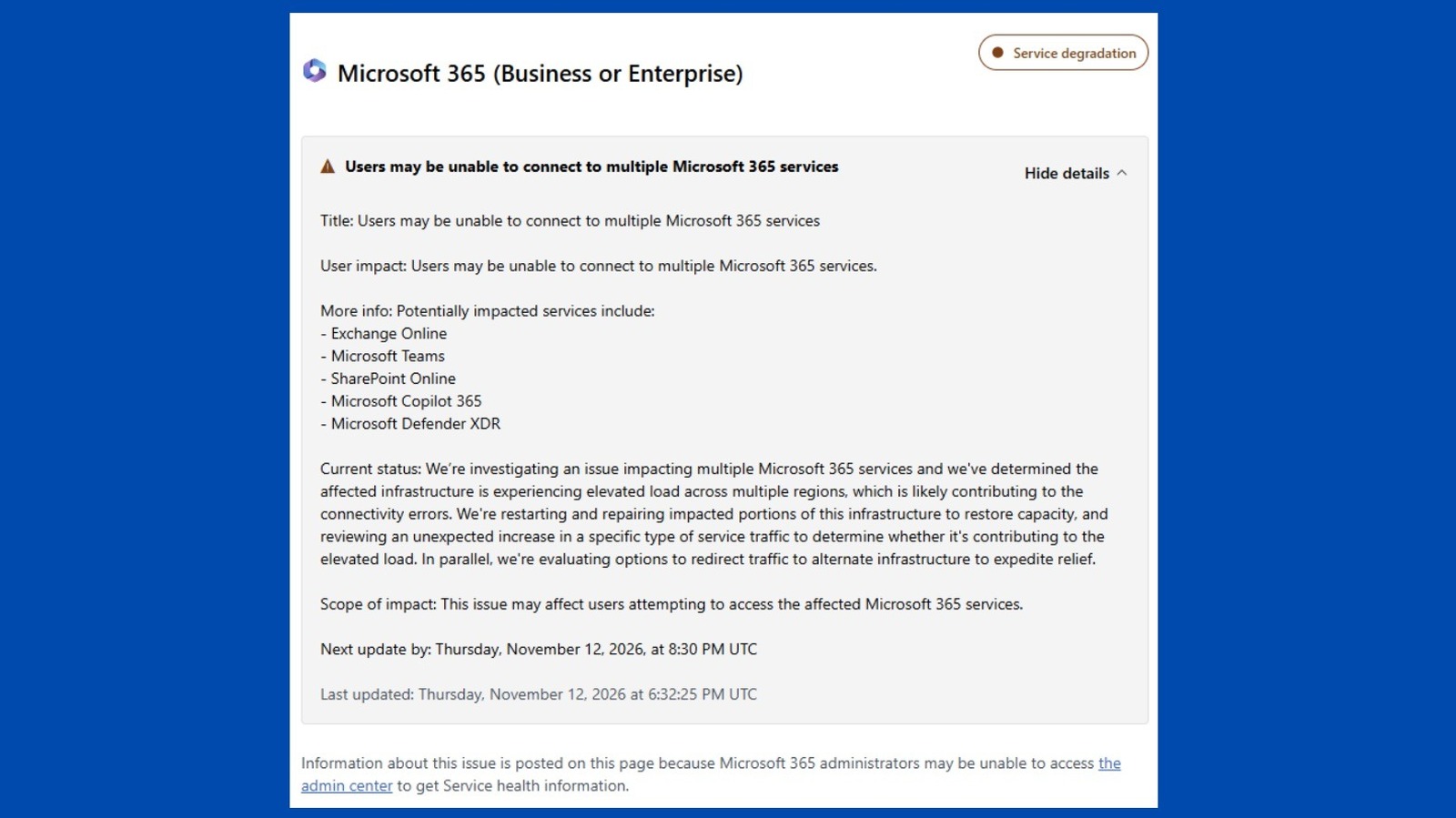
Microsoft, Outlook and Teams outage extends past 12 hours
Microsoft’s Outlook and Teams outage passed 12 hours with no fix in sight, impacting Microsoft 365 users globally, per The Next Web. Microsoft later said the incident was tied to a “network capacity upgrade” and not related to cyber or AI/agents, per @microsoft.
Two things can be true: the root cause can be mundane, and the operational impact can still be systemic. The more “work” collapses into a small set of SaaS control points, the more outages become cross-functional failures, legal can’t file, support can’t respond, finance can’t reconcile, engineering can’t coordinate.
The Bet: Enterprises will accept platform concentration as long as vendors can keep reliability within a tolerable band.
So What? This is less about Microsoft and more about dependency design. Many organizations still treat collaboration tools as utilities, not as critical infrastructure with explicit resilience requirements. But the collaboration layer is now the coordination plane for every other incident, including security incidents. If your response plan assumes Teams/email is available to coordinate the response to the outage of Teams/email, you have a circular dependency.
There’s also a second-order AI implication. As copilots and agent workflows embed into the productivity stack, outages don’t just pause communication, they pause automations, approvals, and delegated work. The “agent era” increases the blast radius of reliability events because more work becomes asynchronous and tool-mediated.
The Risk: Teams may overreact by building parallel stacks they won’t maintain, shadow tooling that creates security and compliance gaps. The right answer is usually a thin, rehearsed fallback, not a second full platform.
Action:
- Run a 60-minute tabletop this week: “Teams and email are down for 10 hours”, document what breaks and what you do instead.
- Stand up an out-of-band comms channel (phone tree, Signal group, alternate email domain) and test it quarterly.
- Identify the workflows that silently depend on 365 APIs (approvals, ticketing, CRM sync), add monitoring and manual fallbacks.

GOVERNANCE / COMPUTE SUPPLY
Export controls are porous, enforcement is fragmented, and operators eat the variance
China model training, export-banned Nvidia chips reportedly in the stack
Reporting indicated that China’s most powerful AI models were trained using export-banned Nvidia chips, per TechCrunch. Separately, reporting described a “blame game” between U.S. Treasury and Commerce over enforcement related to Nvidia chip sales to China, per Gizmodo.
This is the operational reality of hardware controls: the rules can be strict on paper and leaky in practice. That leakiness doesn’t make the rules irrelevant. It makes them unpredictable, and unpredictability is what breaks planning.
The Bet: Policymakers can meaningfully shape frontier capability by constraining access to top-tier accelerators.
So What? For operators, the takeaway is not “controls don’t work.” It’s that controls create variance, and variance is what you need to manage. If you’re building products with hard compute assumptions (training schedules, inference unit economics, delivery commitments), you need a policy volatility plan the same way you need a power and cooling plan.
This also changes compliance posture. If enforcement is multi-agency and interpretations differ, “we followed the rules as we understood them” is not a sufficient internal standard. You need documentation, chain-of-custody discipline, and contractual language with suppliers and resellers that anticipates retroactive scrutiny.
The Risk: Teams may treat this as a China-only issue and miss the broader pattern: export controls tend to expand in scope, not contract, and enforcement often arrives after the market has already adapted. That lag is where reputational and legal exposure accumulates.
Action:
- Map your accelerator dependencies by SKU and geography, include resellers and secondary procurement paths.
- Add a policy-volatility clause to capacity planning: identify which launches slip if supply tightens 20% and what you’d cut first.
- Tighten procurement documentation now, require provenance and resale restrictions for any restricted-class hardware.
CAPITAL FLOWS / AI INFRA
GPU commitments are turning into balance-sheet events
Nscale, filing warns it needs more funding after Nvidia orders tied to a $45B Anthropic deal
Nscale said in a filing it needs more funding for its 2027 commitments after ordering Nvidia chips for a $45B Anthropic deal, raising questions about its planned $35B IPO, per Financial Times.
This is what “AI infrastructure” looks like when it stops being a narrative and becomes a contract. Multi-year GPU commitments are not just capex. They’re financing structures, delivery risk, and margin risk, and they can outrun the balance sheet faster than most teams expect.
The Bet: Demand for contracted compute will stay strong enough that pre-buying capacity is rational, even with financing risk.
So What? The market is learning that the scarce resource isn’t only GPUs. It’s credible balance sheets that can carry GPU obligations through delivery delays, pricing shifts, and customer renegotiations. That creates a wedge between “can sign the deal” and “can survive the deal.”
For builders buying capacity, this matters because your counterparty risk is rising. If your compute provider is financing inventory and buildouts aggressively, you need to understand what happens to your contract if they need to refinance, restructure, or slow deployments. Reliability isn’t just an SRE question anymore. It’s a capital structure question.
The Risk: Overcorrection is possible, providers may pull back on commitments, tightening supply and raising prices in the near term. And customers may discover that “reserved capacity” is only as good as the provider’s ability to deliver power, space, and hardware on schedule.
Action:
- Ask your compute providers for their delivery dependencies, power, interconnect, hardware lead times, and document what’s assumed vs contracted.
- Review your contracts for step-in rights, termination clauses, and remedies tied to delivery slippage.
- Diversify capacity across at least two procurement paths (cloud + specialist, or two specialists) for any roadmap-critical workload.
CONTRARIAN SIGNAL
The wallet is a governance product, not a commerce product
The obvious read on ChatGPT Wallet is “OpenAI is moving into payments.” That’s true, but incomplete.
The deeper move is permissioning. A wallet inside the assistant is a way to standardize delegation: spend limits, confirmation thresholds, audit logs, and dispute workflows. Those are governance primitives. Commerce is simply the first high-frequency domain where users feel the pain of delegation without guardrails.
If this pattern holds, expect the same structure to show up elsewhere: “agent keys” for SaaS actions, “agent credentials” for identity, “agent budgets” for cloud spend. Not because vendors want to control users, but because execution without bounded authority doesn’t scale.
The Takeaway: The next competitive surface for agents is not raw capability. It’s controllable execution, the ability to delegate without losing the ability to explain, reverse, and constrain.
THE QUESTION FOR TODAY
Agents are being handed payment rails. Collaboration platforms are showing their fragility. Export controls are creating compute variance, not compute certainty. And AI infrastructure providers are discovering that commitments can outrun capital.
Where are you delegating execution today, money, approvals, deployments, procurement, without a tested rollback path and a named human owner?
Signal + Noise is strategic intelligence, not engagement-specific advice. For guidance calibrated to your org, start with Advisory.
See exactly how this impacts your specific industry and function. Upgrade to PRO to get bespoke tactical breakdowns generated instantly for your operating model.
Go deeper with the Weekly Signal
This is the daily take. The Weekly goes further — full strategic analysis across 8–10 sections, each with a signal read and operator action items. Source panel included.
Sign up free → then upgrade